Telecommunications Cybersecurity Malaysia
Cybersecurity for Malaysian telcos, ISPs, and MVNOs. MCMC licensing obligations, Cyber Security Act 2024 NCII designation, SS7/Diameter signaling hardening, SIM-swap fraud defence, and an IR retainer sized for operator scale — not enterprise assumptions.
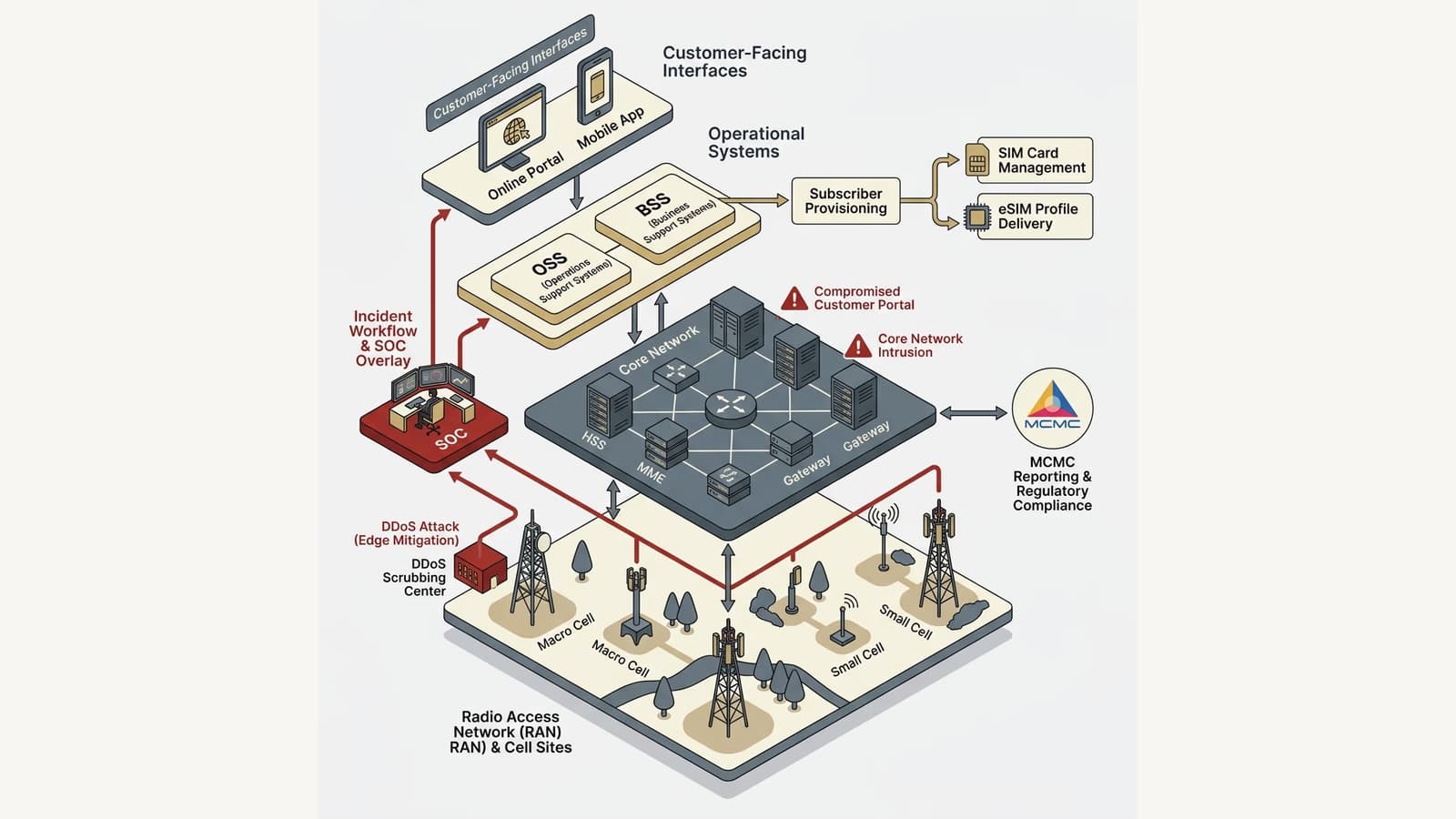
The telco threat profile — critical infrastructure with a uniquely wide attack surface
A mobile network operator or ISP is not simply a large enterprise with a big IT estate. It is simultaneously a communications infrastructure provider, a personal data processor for millions of subscribers, a wholesale interconnect partner, and — under Malaysian law — a National Critical Information Infrastructure operator. The attack surface is correspondingly wide, extending from the customer-facing web and app layer all the way to physical tower sites, the radio access network, the mobile core, OSS/BSS back-office systems, and signaling interconnect with foreign roaming partners.
The threat actor set is diverse. Organised financial crime targets subscribers via SIM-swap fraud — hijacking phone numbers to intercept SMS-based banking OTPs. State-aligned actors have demonstrated the capability and willingness to exploit SS7 and Diameter signaling to track subscriber location and intercept communications without physical access to the network, using access acquired through compromised interconnect partners. Ransomware operators have begun targeting OSS/BSS systems specifically because an operator desperate to restore billing and provisioning functions presents a compelling extortion target. Insider threat — from contact-centre agents enabling SIM swaps for a fee, to field engineers with physical access to remote tower equipment — is a persistent and undermonitored risk in the telco environment.
nCrypt approaches telco security through four concrete threat scenarios that drive assessment scope and detection investment:
- SS7/Diameter signaling abuse. An adversary with access to an interconnect point — available on the grey market for a few thousand dollars — uses MAP (Mobile Application Part) queries to extract subscriber home location register data, intercept SMS OTPs, and track the real-time physical location of targeted subscribers. The attack is transparent to the victim and leaves no trace in the operator's customer-facing logs. Detection requires a dedicated signaling firewall or monitoring layer on the SS7/Diameter interface, with alerting tuned to query-velocity anomalies and off-net subscriber interrogation patterns. nCrypt's signaling assessments help prepare for GSMA FS.11 and FS.19 hardening guidelines.
- SIM-swap and eSIM provisioning fraud. A fraud ring identifies high-value targets — typically individuals with known cryptocurrency holdings or significant banking balances — and social-engineers the operator's retail or contact-centre channel to transfer the victim's number to an attacker-controlled SIM. In parallel, eSIM provisioning abuse targets the SM-DP+ remote provisioning interface, exploiting weak authentication or rate-limiting to activate fraudulent eSIM profiles. Detection maps to SIM change velocity monitoring, identity-verification strength at the point of SIM change, and anomaly alerting when a number receives inbound OTP traffic immediately after a SIM change.
- OSS/BSS exfiltration and ransomware. The OSS/BSS layer holds the complete subscriber record — billing, payment, identity, usage history, device details, and in some architectures the authentication database itself. An adversary who compromises the OSS/BSS layer can exfiltrate millions of subscriber records in a single operation. The same layer is also the target for ransomware operators: encrypting billing and provisioning systems creates immediate service and revenue impact, maximising extortion leverage. Access paths frequently run through third-party vendor support channels — managed-services partners with persistent remote access that is rarely subject to the same authentication and monitoring standards as internal staff.
- DDoS on network edge and lawful intercept exposure. Volumetric DDoS targeting a telco's network edge degrades service quality for thousands of downstream customers simultaneously and can affect the operator's ability to fulfil lawful intercept obligations — a legally sensitive failure mode in a regulated environment. Separately, lawful intercept systems themselves represent a high-value target: compromise of the intercept management system would allow an adversary to redirect or suppress court-ordered intercepts, or to add unauthorised intercept targets. Physical access to tower sites or exchange infrastructure amplifies both risks by enabling passive tap and equipment tampering.
MCMC, Cyber Security Act 2024, and PDPA — the stacked telco regulatory framework
Malaysian telecommunications operators face cybersecurity obligations from multiple concurrent regulatory frameworks, each with different triggers, evidence requirements, and penalty regimes. Understanding how they stack — and where they overlap — is essential for building a compliance programme that satisfies all three without duplicating effort.
MCMC regulates Malaysian telecommunications providers under the Communications and Multimedia Act 1998 and the Malaysian Communications and Multimedia Commission Act 1998. MCMC licensing conditions include network resilience and security obligations, and MCMC has the power to issue mandatory standards and directions on security matters. The Communications and Multimedia (Technical Standards) Forum produces technical codes — including codes covering network security, numbering, and interconnect — that licensed operators are expected to adopt. MCMC's oversight of lawful intercept obligations under the Communications and Multimedia Act adds a further layer: operators must maintain compliant lawful intercept capability and protect it from compromise, a requirement that directly maps to cybersecurity controls on the intercept management system.
The Cyber Security Act 2024 designates telecommunications as one of eleven National Critical Information Infrastructure sectors. NCII operators — those designated by NACSA — must engage licensed cybersecurity service providers (CSPs) for risk assessments and audits, report incidents to NACSA, and comply with NACSA directions following a significant cybersecurity incident. nCrypt's assessments help prepare for the NCII audit cycle and produce evidence packs structured to map to NACSA's framework requirements.
PDPA 2024 applies to subscriber data — and for a Malaysian mobile operator or ISP, the scope of that data is substantial. Call data records, subscriber location records, device identifiers, browsing metadata (where collected under the network), billing and payment records, and identity documents all fall within PDPA's personal data definition. The 2024 amendment introduces mandatory breach notification where a data breach is likely to result in significant harm, a Data Protection Officer appointment obligation, and tightened cross-border transfer rules. The cross-border rule is particularly relevant to operators with offshore CDR processing, cloud analytics partners, or roaming data exchange with foreign carriers.
nCrypt designs telco engagements to satisfy MCMC security obligations, the NCII regime, and PDPA simultaneously — producing a single evidence set that maps across all three frameworks wherever the underlying controls overlap.
Mapping the telco attack surface — from customer portal to cell site
A telco security assessment must cover the full architecture, not just the internet-facing perimeter. The six layers below define the scope nCrypt applies to network operator engagements:
| Layer | Key Components | Primary Risk |
|---|---|---|
| Customer portal | Self-service web/app, MyInfo integration, billing portal, SIM replacement workflow | Account takeover, SIM-swap via weak identity verification, credential stuffing |
| OSS/BSS | Provisioning, billing, CRM, order management, vendor support access | Mass subscriber data exfiltration, ransomware, privileged insider abuse |
| Signaling | SS7 MAP/CAP, Diameter Cx/Sh/Rf, 5G SBA HTTP/2 interfaces, interconnect gateways | Location tracking, SMS interception, call redirect, subscriber enumeration |
| Network core | EPC (4G), 5G core (5GC), IMS, lawful intercept management, roaming gateway | Intercept system compromise, core function disruption, mass data access |
| Cell sites | Base stations (eNodeB/gNB), transport links, tower-sharing tenants, physical access controls | Physical tampering, passive traffic capture, firmware modification, coordinated outage |
| Partner peering | Wholesale interconnect, roaming partners, MVNO host agreements, CDN and transit peers | Third-party signaling abuse, roaming data leakage, MVNO security deficiency affecting host |
nCrypt's network penetration testing scope covers the customer portal, OSS/BSS API surface, signaling interfaces, and partner peering points. Physical site security — tower access controls, cable management, equipment tamper-evidence — is included in full-scope operator engagements.
Managed-services partners, field engineers, and tower operations risk
The modern Malaysian telco operates with a deeply distributed third-party ecosystem. Tower infrastructure is typically owned and operated by separate tower companies (towercos), with multi-tenant arrangements bringing additional operators — and their field engineers — into the same physical space. Network equipment is maintained under vendor support contracts that grant persistent remote access to OSS and network management systems. OSS/BSS platforms are frequently managed by system integrators with standing privileged access. Contact centres may be outsourced, adding a retail and customer-service layer that sits outside the operator's direct security controls but has the ability to process SIM changes, account password resets, and subscriber data lookups.
Each of these third-party relationships represents a trust extension that needs to be evaluated on its own terms. The risk profile of a towerco field engineer with physical access to a base station is fundamentally different from the risk profile of a billing system vendor with remote database access — but both are real risks and both are commonly under-audited relative to the operator's internal security posture.
nCrypt's third-party risk work for telcos covers vendor access control review (who has remote access, to what systems, under what authentication and monitoring conditions), towerco physical security assessment, contact-centre identity-verification process review for SIM-change and account-change workflows, and contractual security baseline review for managed-services agreements. This work supports the operator's NCII supply chain risk obligations under the Cyber Security Act 2024 and the broader third-party risk management expectations embedded in MCMC licensing and PDPA processor agreements.
SOC, threat intelligence, and incident response built for network operator scale
Telco security operations differ from enterprise SOC in two material ways: scale and criticality. An operator's network generates several orders of magnitude more security-relevant events than an enterprise of equivalent revenue — CDR flows, signaling interface traffic, network element syslog, and subscriber authentication events collectively represent a data volume that cannot be processed by traditional enterprise SIEM rules without significant tuning. And the consequences of a missed event are different: a compromised lawful intercept system, an SS7 attack actively tracking a subscriber, or a ransomware encryption of OSS provisioning systems is not a contained IT incident — it is a regulated operator's core function under attack.
nCrypt's SOC service for telcos is scoped for this environment. Detection content covers SIM-swap velocity anomalies (abnormal SIM change rates per agent, per retail location, or on specific high-value numbers), CDR access anomalies (bulk subscriber record access outside normal operational patterns), OSS/BSS privileged session monitoring, signaling anomaly alerting (where the operator has deployed a signaling firewall or monitoring probe), and physical access event correlation from tower and exchange CCTV and access-control systems. Escalation runbooks are pre-cleared for MCMC and NACSA notification, so that the first hour of a major incident is spent on containment, not governance.
Threat intelligence for telcos has a distinct profile. SS7/Diameter threat actors, SIM-swap fraud rings, DDoS-for-hire services targeting operator infrastructure, and adversarial activity on eSIM provisioning surfaces are telco-specific intelligence requirements that generic threat feeds do not adequately cover. nCrypt curates telco-relevant intelligence from GSMA, regional CERT networks, and commercial signaling-security intelligence sources, delivered in operator-operational formats rather than generic indicator dumps.
The incident response retainer for telcos is pre-positioned with scenario runbooks for CDR exfiltration, signaling abuse, insider SIM-swap campaign, lawful-intercept system compromise, ransomware on OSS/BSS, and coordinated physical-plus-cyber attack. MCMC and NACSA notification timelines are mapped and pre-approved within the retainer documentation, so that regulatory obligations are not being researched during the first 24 hours of an active incident.
Our telco security service stack
Network Infrastructure Penetration Testing
External and internal testing of network edge, signaling interfaces (SS7/Diameter/SBA), OSS/BSS APIs, provisioning systems, and partner peering points. Maps to GSMA FS.11 and NACSA audit criteria.
SOC-as-a-Service for Network Operators
Telco-grade 24/7 SOC covering CDR anomaly detection, SIM-swap velocity monitoring, OSS/BSS privileged-access alerting, and signaling threat intelligence. Built for operator scale.
Threat Intelligence — Signaling & Subscriber
Curated intelligence on SS7/Diameter threat actors, SIM-swap fraud rings, DDoS-for-hire targeting operator infrastructure, and adversarial activity on eSIM provisioning surfaces.
Incident Response Retainer
Pre-positioned retainer covering CDR exfiltration, signaling abuse, lawful-intercept system compromise, insider SIM-swap campaigns, and ransomware on OSS/BSS. MCMC and NACSA notification playbooks included.
Cyber Security Act 2024 NCII Readiness
Gap assessment against NACSA's NCII risk framework, evidence pack for the NCII audit cycle, and expert-delivered assessment reports built for NACSA.
PDPA 2024 Subscriber Data Readiness
CDR data classification, breach notification runbook, DPO governance, cross-border transfer review for roaming and offshore analytics partners. Maps to amended PDPA obligations for telcos.
Frequently asked questions
How does the Cyber Security Act 2024 apply to Malaysian telcos?
The Cyber Security Act 2024 empowers NACSA to designate National Critical Information Infrastructure (NCII) across eleven prescribed sectors. Telecommunications is explicitly listed as one of those sectors. Telcos designated as NCII operators must conduct risk assessments against the NCII risk assessment framework, submit to audits by licensed cybersecurity service providers, report cybersecurity incidents to NACSA within prescribed timelines, and comply with NACSA directions following an incident. The NCII designation sits on top of — and does not replace — MCMC's separate Communications and Multimedia Act obligations and PDPA's subscriber data requirements. A Malaysian telco therefore operates under a stacked regulatory framework: MCMC licensing conditions, the Cyber Security Act 2024 NCII regime, and PDPA 2024. nCrypt helps prepare for all three simultaneously, using a single evidence set wherever frameworks overlap.
What is SS7 and Diameter signaling abuse, and is it still relevant to Malaysian operators?
SS7 (Signalling System No. 7) is the protocol stack that underpins traditional telephony interconnect — call routing, SMS delivery, roaming authentication and lawful intercept triggering. Diameter is its successor, used in 4G LTE for authentication, authorisation and accounting across roaming partners. Both protocols were designed in an era of trusted interconnect among a small number of national carriers; neither was built to resist an adversary who gains access to an interconnect point. In practice, SS7 access is available on the grey market for a few thousand dollars, enabling call interception, SMS interception (and therefore 2FA bypass), real-time subscriber location tracking, and forced service denial. Diameter carries similar risks at the 4G layer. These are not theoretical — SS7 attacks against financial OTPs have been documented in Europe, Africa, and Southeast Asia. 5G introduces a new signalling layer (HTTP/2-based SBA interfaces), which carries different but comparably serious risks if not hardened. Malaysian operators running hybrid 2G/3G/4G/5G stacks face all of these layers simultaneously. nCrypt's signaling security assessments map to GSMA FS.11 and FS.19 guidelines.
What does SIM-swap fraud look like from a security operations perspective?
A SIM-swap attack is a social engineering or insider attack targeting the operator's customer service or retail channel, where the adversary convinces an agent to transfer a victim's phone number to an attacker-controlled SIM. The attack is most commonly used to intercept SMS-based one-time passwords for banking and cryptocurrency platforms. From the operator's security operations perspective, SIM-swap fraud sits at the intersection of identity verification policy failures, insider threat in the retail channel, and inadequate change-velocity monitoring on subscriber management systems. Detection signatures include: multiple SIM changes in a short window, SIM changes followed immediately by inbound OTP traffic on a previously quiet number, SIM changes shortly after an account password reset at a third-party service, and SIM change requests outside customer-normal channels. eSIM remote provisioning adds a new surface — attackers can abuse eSIM activation flows if the operator's provisioning server does not enforce appropriate authentication and rate limiting on the SM-DP+ interface.
What are the PDPA 2024 obligations for telco subscriber data?
Malaysian telcos are among the largest personal data processors in the country, holding name, identity document number, address, payment instrument, device IMEI, location history, call data records (CDR), messaging metadata, and browsing data for millions of subscribers. The PDPA 2024 amendment imposes mandatory breach notification — where a personal data breach is likely to result in significant harm, the telco must notify the Personal Data Protection Commissioner and, where appropriate, affected subscribers within a specified timeframe. For a major operator, even a partial CDR exfiltration almost certainly meets the significant-harm threshold. PDPA 2024 also introduces a Data Protection Officer appointment obligation for qualifying data controllers and tightens cross-border personal data transfer rules, which are materially relevant to operators running roaming agreements, CDR storage or analytics with offshore partners. nCrypt's PDPA readiness work for telcos maps to these specific obligations.
How does DDoS defence work differently for a telco versus an enterprise?
An enterprise facing a DDoS attack can generally absorb or deflect at the upstream ISP level — ultimately the threat is to application availability. A telco IS the upstream. A volumetric DDoS targeting a telco's network edge can degrade service quality for thousands of downstream customers and enterprise clients simultaneously, affect lawful intercept infrastructure, and in extreme cases trigger emergency-services availability obligations under MCMC licensing conditions. Telco DDoS defence therefore operates at a different scale and with different stakes — BGP-level traffic scrubbing, anycast-based mitigation, carrier-grade firewall capacity, and inter-operator signaling co-ordination via bodies such as MYREN or bilateral peering agreements. nCrypt supports operators in assessing network edge resilience, stress-testing mitigation runbooks, and reviewing out-of-band communications procedures for major volumetric events.
What are the security risks in OSS/BSS systems specific to telcos?
Operations Support Systems (OSS) and Business Support Systems (BSS) are the software layers that manage network provisioning, configuration, subscriber billing, customer relationship management, order management, and service assurance for a telco. They are high-value targets for two reasons. First, access to OSS provides the ability to provision services, redirect traffic, modify routing, and observe real-time network state — an adversary with OSS access effectively has administrative control over the network. Second, BSS systems hold the complete subscriber data set — billing records, payment instruments, usage history, plan configuration, device details, and in some architectures the authentication credentials themselves. OSS/BSS security assessments cover authentication hardening on north-south APIs, privilege separation for provisioning and billing functions, segregation between operational and customer data environments, and the vendor support access surface — many OSS/BSS platforms are maintained by third-party vendors with persistent remote access that is rarely audited.
Do tower sites and field operations create a meaningful cyber risk for telcos?
Yes, and it is consistently underestimated relative to the IT security budget. Tower sites typically house base station equipment that communicates with the radio network controller or core network over dedicated or shared WAN links. Physical access to a tower site — for which multi-tenant sharing arrangements often involve several third-party managed-services providers, infrastructure companies, and field engineers — can enable passive traffic capture, firmware modification on base station equipment, network cable interception, or destruction of physical infrastructure as part of a broader coordinated attack. The risk is compounded in a 5G environment where some architecture patterns push compute closer to the network edge (multi-access edge computing), increasing the sensitivity of what sits at a remote, often minimally physically secured, site. Site security assessment — physical access controls, cable management, equipment tamper-evidence — is part of nCrypt's telco security scope.
How is an IR retainer for a telco different from a standard enterprise retainer?
A telco IR retainer must be sized for the operator's scale and pre-cleared for out-of-hours escalation given the 24/7 nature of network operations. Beyond scale, the retainer scenario set differs. Pre-positioned scenarios should include: mass CDR exfiltration (subscriber data breach), SS7/Diameter signaling abuse enabling subscriber location or intercept, SIM-swap fraud campaign driven by insider access, ransomware targeting OSS/BSS systems, lawful intercept system compromise (with associated regulatory notification obligations to MCMC and relevant law enforcement), and coordinated physical-plus-cyber attack on tower or exchange infrastructure. The retainer should also pre-clear the MCMC and NACSA incident notification process — who at the operator triggers it, within what timeframe, and what the operator's legal obligations are around subscriber notification. nCrypt's IR retainer for telcos pre-maps all of these regulatory touchpoints so that the first hours of an incident are not spent deciding who to call.
Secure your network and subscribers
30-minute scoping call with a telco-experienced consultant. MCMC obligations, NCII audit readiness, signaling security, and PDPA 2024 alignment — scoped together.
Request Telco Scoping CallTailored security for telecommunications operators
Share your scope. We'll come back with a fixed-fee proposal.
Get a Free Quote
Fill out the form and we'll reply within 1 business day.
Not sure what you need?
Tell us what needs testing and we come back with a fixed fee within 48 hours — no hourly estimates.