Loading...
Loading...
Cybersecurity built for the Malaysian financial sector — banks, DFIs, insurers, fintechs, e-wallets and payment gateways. BNM RMiT 2025 alignment, PCI DSS, PDPA 2024 readiness, intelligence-led red-team, CREST-aligned pentest and a 24/7 SOC designed for core banking, SWIFT and payment-rails realities.
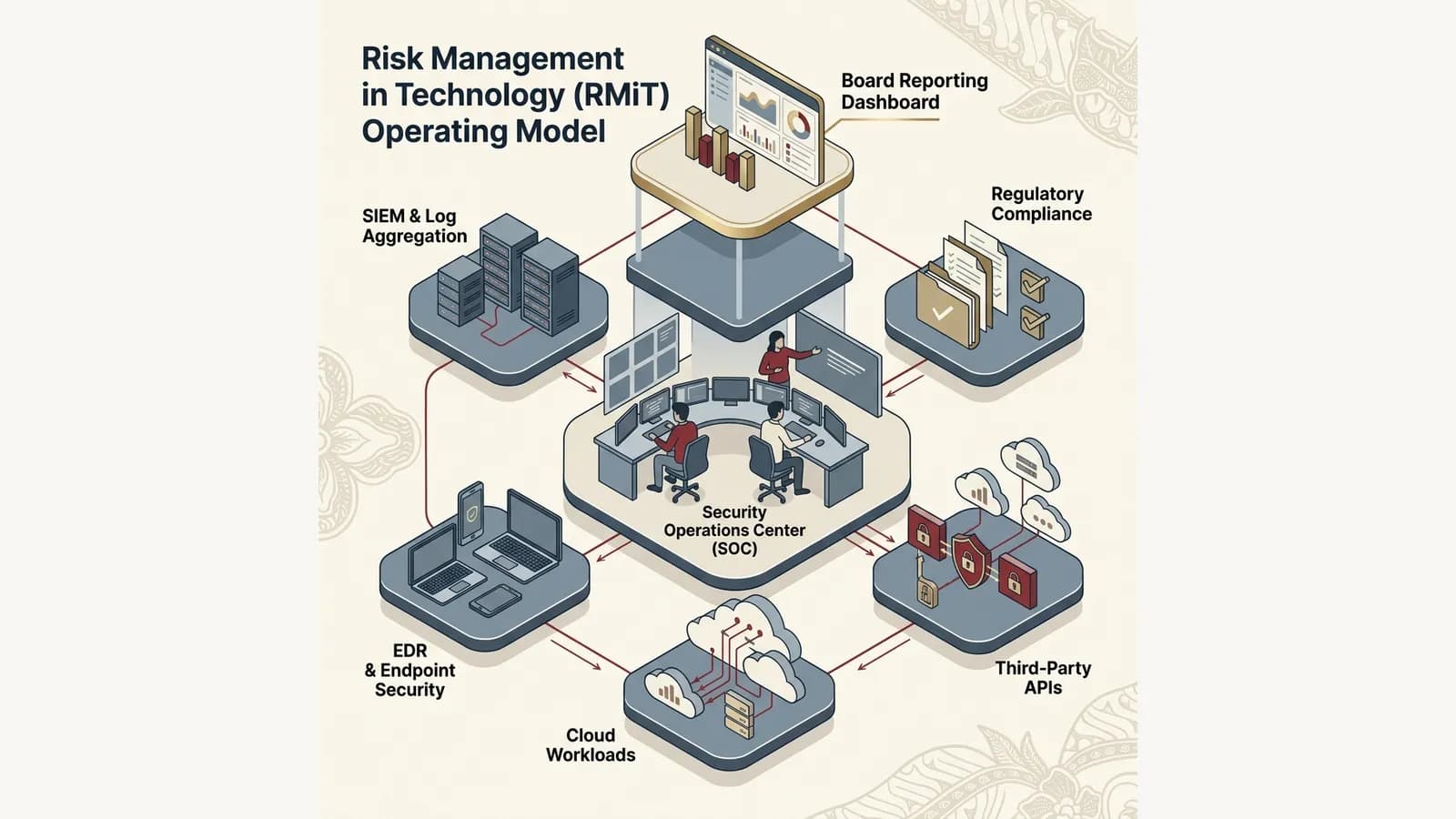
The Malaysian financial sector is not a monolith and the threat profile reads segment by segment. Licensed commercial banks carry the broadest surface — core banking, card management, ATM switch, internet and mobile banking, SWIFT, treasury and bancassurance integrations. Development financial institutions carry a narrower retail surface but disproportionate exposure on corporate, syndicated lending and government-mandate flows. Insurers and takaful operators carry deep policyholder data and an increasingly digital claims and distribution stack. Fintechs and e-wallets carry narrow but high-velocity payment flows, with API surfaces mature attackers probe continuously. Payment gateways sit at the intersection of merchant, acquirer and scheme and inherit obligations from all three.
Five concrete attack scenarios dominate regional incident history. First, SWIFT fraud — Bangladesh Bank style operator-PC compromise moving funds via fraudulent payment instructions, still the highest-impact single-incident scenario for a Malaysian bank. Second, ATM jackpotting combining card data, switch manipulation and physical money-mule networks. Third, fintech and open-banking API abuse — credential stuffing, broken object-level authorisation, business-logic abuse against transfer, top-up and refund endpoints. Fourth, business email compromise against treasury and corporate banking flows, where one convincing payment instruction can move seven-figure sums before reconciliation catches it. Fifth, ransomware against core banking and policy administration estates, where downtime translates immediately into regulatory notification and reputational damage.
nCrypt's financial-services practice is built around these scenarios, with CREST-aligned pentest, SWIFT CSP assessment, red-team and 24/7 SOC as the load-bearing capabilities and an IR retainer pre-positioned for the specific regulatory notification matrix that Malaysian financial institutions carry.
Bank Negara Malaysia's Risk Management in Technology policy document is the load-bearing technology risk framework for the Malaysian financial sector, applying to licensed banks, Islamic banks, insurers, takaful operators, DFIs and prescribed payment system operators. The 2024–2025 RMiT cycle sharpened expectations on continuous control monitoring, board-level reporting cadence, third-party visibility, adversarial testing depth and incident notification timelines. See our RMiT compliance page for the control mapping detail.
PCI DSS applies to every entity that stores, processes or transmits cardholder data. PCI DSS v4.x sharpened expectations around authenticated scanning, customised approach controls, targeted risk analyses and continuous evidence rather than point-in-time attestation. nCrypt's PCI DSS practice is designed to scope card environments tightly, reduce scope where tokenisation and segmentation permit, and produce evidence that supports the assessor's report on compliance.
The PDPA 2024 amendment overlays mandatory breach notification to the Personal Data Protection Commissioner within a specified timeframe, positive Data Protection Officer appointment, and tightened cross-border transfer rules. For institutions carrying full KYC and transaction data on millions of customers, the threshold for a notifiable breach is low.
The Cyber Security Act 2024 permits NACSA to designate banking and finance entities as National Critical Information Infrastructure. Tier-1 banks, major DFIs and systemically important payment system operators sit within the credible NCII candidate set, adding licensed cybersecurity service provider procurement, additional audit cadence and incident reporting to the existing BNM regime.
Conventional pentest answers a control question — are defined controls on the defined scope working today? Intelligence-led red-team answers an outcome question — can a determined adversary achieve a defined objective against the live estate undetected? The Malaysian financial sector needs both, sequenced to maturity. nCrypt's programme typically begins with layered CREST-aligned pentest — external, internal, internet and mobile banking, ATM switch where in scope, segmentation, cloud workload and the rapidly expanding API attack surface fintechs and banks expose to partners, aggregators and customers.
Intelligence-led red-team layers on top with objectives drawn from real sector threat history — exfiltrate a defined customer data set, move a test transaction via the SWIFT secure zone, achieve admin on the card management system, compromise the privileged access path used by a named third party. The exercise measures detection and response as much as control presence.
SWIFT assessment is a discrete discipline. nCrypt's SWIFT assessment covers secure zone architecture, operator PC hygiene, privileged access, message integrity, anomaly detection and IR readiness, with evidence sequenced to feed both the CSCF attestation and broader RMiT payments evidence.
Third-party privileged access is the systemically under-tested surface across the Malaysian financial sector. Vendors with remote administrative access into core banking, card platforms, ATM networks and SWIFT-adjacent systems carry attack paths that perimeter testing routinely misses. nCrypt's third-party risk assessment maps the privileged access topology, tests the controls and produces the evidence RMiT third-party obligations increasingly expect.
Control mapping against the latest RMiT cyber risk management, cyber resilience, third-party technology risk and cyber operations centre obligations, designed to support board reporting and examiner enquiry.
Objective-based adversarial testing of the live estate — customer data exfiltration, SWIFT misuse, card environment compromise — measured against detection and response maturity rather than only control presence.
Conventional pentest scopes across internet and mobile banking, ATM switch, core banking integration, internal segmentation, cloud workloads and the public API surface that fintechs and banks increasingly expose.
Independent assessment against the SWIFT Customer Security Controls Framework — secure zone, operator PC, privileged access, message integrity, anomaly detection and incident response.
Sector-tuned use cases for core banking, card management, payment gateway, ATM switch, internet and mobile banking, with evidence formatted for RMiT cyber operations centre obligations.
Pre-positioned for SWIFT fraud, ATM jackpotting, card data exfiltration, fintech API abuse, BEC against treasury and ransomware on core banking. Regulatory notification matrix pre-arranged.
The deliverable is the durable evidence pack a financial institution presents to internal audit, the board technology and risk committee, BNM examiners and, where applicable, NACSA. The RMiT control mapping references each tested control to the relevant RMiT paragraph, with severity and business impact rated against a methodology the assessor can stand behind under examination. The technical findings register is written for the remediating engineering team, with reproducible steps and recommended controls keyed to the institution's existing tooling.
The SOC runbook deliverable converts every successful attack path from the engagement into a detection use case, analyst runbook entry and tabletop scenario the institution's own SOC can rehearse against on an ongoing basis. The incident reporting drill log demonstrates that the institution can produce a BNM-grade notification within regime timelines, with role clarity across CISO, CIO, legal, communications and board liaison. The board summary translates the technical posture into the language the technology and risk committee consumes — current posture, residual risk after remediation, and the recommended sequencing of remediation investment.
Week 1 to 2 is scope definition and control mapping. nCrypt and the CISO office agree the in-scope estate — core banking, internet and mobile banking, ATM switch, card management, SWIFT secure zone, payment gateway, third-party privileged access, cloud and API surfaces. RMiT control mapping is laid down so every subsequent test produces evidence keyed to the right paragraph from the start.
Week 3 to 6 is the active testing window. Conventional pentest runs against the agreed scope. Where maturity supports it, red-team runs in parallel against named objectives, with the SOC tested as a control surface in its own right. SWIFT CSP assessment, where in scope, runs as a discrete workstream against the CSCF control set. PCI DSS scope and gap work runs as a parallel workstream with shared evidence collection.
Week 7 to 10 is remediation and re-test. Findings are converted into engineering tickets, sequenced by severity and remediation cost. nCrypt re-tests material fixes and updates the SOC runbook so engagement learning becomes durable detection. The incident response retainer is activated where the engagement surfaced material IR gaps.
Week 11 to 13 is board reporting and the regulatory drill. The board-ready executive summary is finalised and the incident reporting drill runs end-to-end — simulated incident, BNM notification production, PDPA notification where warranted, board liaison and external communications. The drill log becomes a durable artefact in the institution's evidence library.
BNM's RMiT policy document has been periodically updated since 2020, with the 2024–2025 cycle sharpening cyber resilience, cyber operations centre and third-party technology risk obligations. Practical changes include broader expectations on continuous control monitoring rather than point-in-time attestation, explicit board-level reporting cadence, deeper third-party visibility, stronger expectations around adversarial testing, and tightened incident notification timelines. nCrypt's RMiT engagements are designed to support institutions in mapping these obligations to evidence — not to guarantee a regulatory outcome, which remains BNM's prerogative.
A generic MSSP delivers SIEM monitoring against a standardised use-case library, with tier-1 triage handed off to the customer. A 24/7 SOC sized for a Malaysian financial institution must understand core banking, card management, internet and mobile banking, ATM switch, SWIFT and payment-gateway integrations as named systems, carry use cases tuned to insider abuse and privileged-access misuse, hold pre-arranged escalation into the CISO and incident commander, and produce evidence mapped to BNM RMiT cyber operations centre obligations.
A conventional pentest is scoped, time-boxed and visible — it answers 'are known controls on this scope working today?'. A red-team exercise is intelligence-led, objective-based and adversarial — it answers 'can a determined adversary achieve a defined objective against the live estate undetected?'. RMiT and peer regulators increasingly expect tier-1 institutions to run intelligence-led red-team annually or biannually as a complement to — not a replacement for — conventional pentest. Smaller institutions and fintechs typically begin with pentest discipline and graduate to red-team once detection and response maturity supports a useful learning outcome.
Threat actors and attack patterns are largely shared — credential abuse, API exploitation, payment interception, social engineering, ransomware. Regulatory scope differs materially. A licensed bank carries the full RMiT obligation set, BNM operational risk capital implications, potential NCII designation, and PCI DSS for card environments. A non-bank fintech or e-wallet operating under BNM's e-money or Payment Systems Act licences carries a proportionate but substantial obligation set, scoped against BNM's e-money policy and relevant payment systems framework. PCI DSS applies wherever card data is stored, processed or transmitted regardless of licence type.
The Cyber Security Act 2024 permits NACSA to designate entities operating National Critical Information Infrastructure across eleven sectors, including banking and finance. A designated NCII entity carries additional risk assessment, audit, incident reporting and licensed cybersecurity service provider procurement obligations on top of the existing BNM regime. Tier-1 Malaysian banks and DFIs are credible NCII candidates given systemic importance. nCrypt's engagements are designed so the evidence pack supports both BNM RMiT submissions and NACSA NCII obligations from a single set of underlying control work.
The evidence pack contains the RMiT control mapping (each tested control referenced to the relevant paragraph), the technical findings register with severity and business impact, SOC runbook updates produced from the engagement, the incident reporting drill log demonstrating timeline adherence, and the board-ready executive summary translating findings into risk posture and remediation roadmap. The pack is designed to map to the typical examiner question set, not to guarantee compliance, which remains BNM's determination.
Yes. The SWIFT Customer Security Programme defines mandatory and advisory controls (the Customer Security Controls Framework) that all users self-attest against annually, with independent assessment expected on a defined cadence. nCrypt's SWIFT assessment covers secure zone architecture, operator PC hygiene, privileged access discipline, message integrity, anomaly detection and IR readiness against the CSCF control set, sequenced to feed both the CSCF attestation and the broader RMiT payments evidence.
30-minute scoping call with a financial-services-credentialed consultant. BNM RMiT 2025, PCI DSS, PDPA 2024, SWIFT CSP and NACSA NCII alignment.
Request Financial Services Scoping CallShare your scope. We'll respond within 24 hours.
Fill out the form and we'll get back to you within 24 hours.