Loading...
Loading...
Cybersecurity for Malaysian hospitals, clinics and medical groups. PDPA 2024 readiness, ransomware resilience for EMR, HIS and PACS, connected medical device assurance, and an incident response retainer built for environments where downtime translates directly into clinical risk.
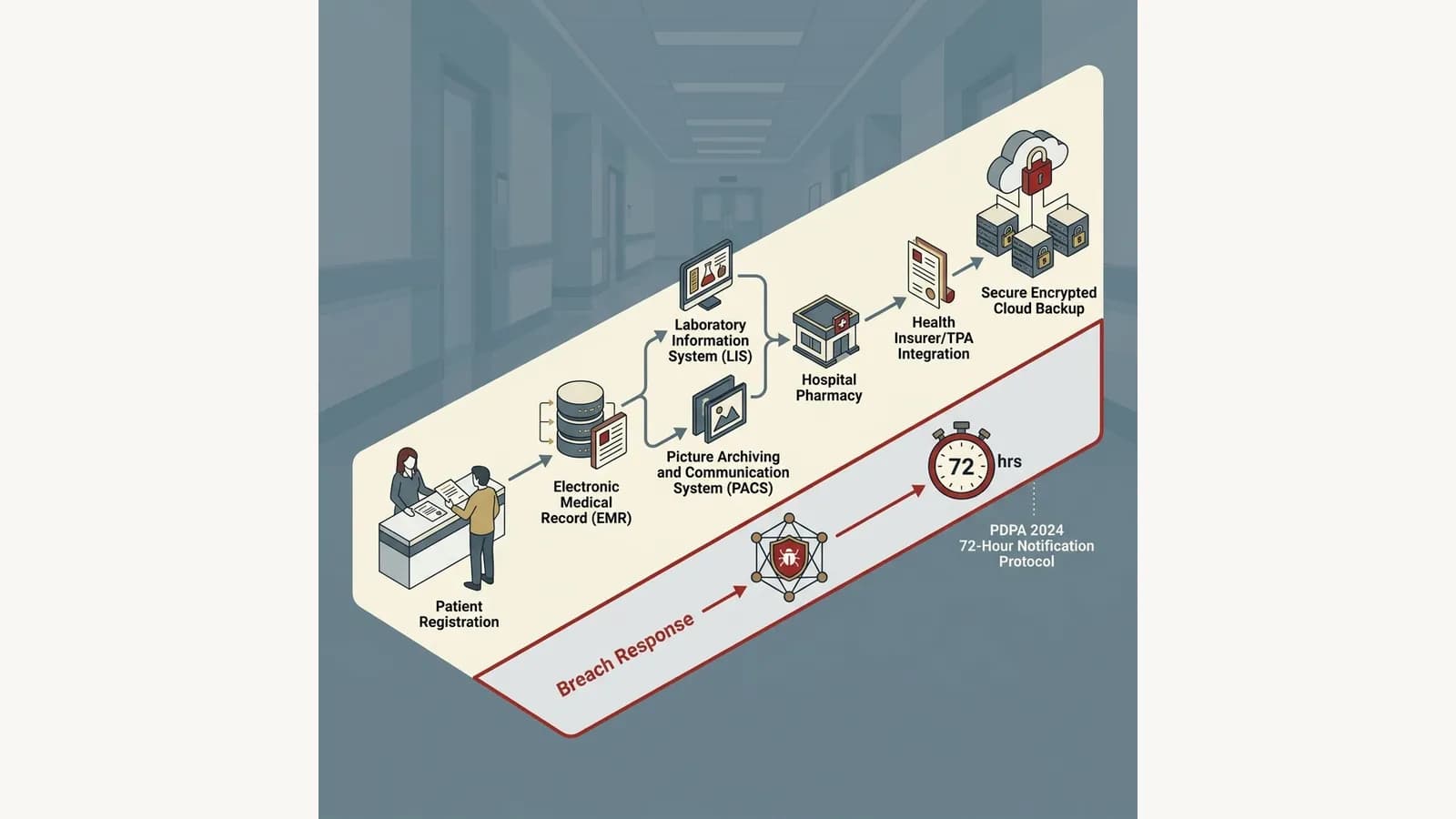
Healthcare is the only sector where a cybersecurity incident routinely translates, within hours, into measurable harm to a human being. A ransomware event that takes down the electronic medical record, the hospital information system and the picture archiving and communication system at the same time forces clinicians to make decisions without access to prior history, prior imaging, current medication lists, current allergy lists, or current laboratory results. Surgery is postponed, ambulances are diverted, the emergency department triages on paper, and the pharmacy verifies orders without the medication reconciliation safety net. International evidence — particularly the 2020 Düsseldorf University Hospital incident and the 2024 Change Healthcare disruption in the United States — has established beyond doubt that healthcare ransomware can and does contribute to patient harm.
Malaysian hospitals and clinics face a threat stack that includes financially motivated ransomware operators (with healthcare consistently in the top three targeted sectors in regional incident data), credential-stuffing attacks against telemedicine and patient portals, business email compromise targeting medical billing and insurer settlement flows, exfiltration-only data theft for resale or extortion, and the steadily growing surface of connected medical devices running unpatched embedded operating systems on flat clinical networks. The records held by a healthcare provider — name, identity card, address, medical history, family history, mental health treatment, fertility treatment, oncology treatment, paediatric records — sit at the very top of the personal data sensitivity hierarchy under the PDPA, and the lifetime consequence of exposure is severe.
Five concrete attack scenarios should drive every Malaysian hospital's threat model. First, ransomware encrypting EMR, HIS and PACS simultaneously, with the backup repository targeted in the same operation. Second, exfiltration of a multi-year patient cohort dataset for resale or double-extortion. Third, compromise of a connected medical device used as a foothold for lateral movement into clinical core systems. Fourth, business email compromise redirecting insurer claims settlement to an attacker-controlled account, with the loss only discovered at month-end reconciliation. Fifth, abuse of an EMR or telemedicine vendor account by an insider or by a compromised third-party support technician with persistent privileged access.
nCrypt's healthcare practice is built around three anchors — PDPA 2024 readiness, ransomware resilience for clinical continuity, and assurance over the third-party software and connected device ecosystem. We deliver these through penetration testing, vulnerability assessment, tabletop exercises and an IR retainer scoped for clinical realities.
The 2024 amendment to the Personal Data Protection Act is the single most consequential regulatory development for Malaysian healthcare cybersecurity in a decade. It introduces mandatory personal data breach notification to the Personal Data Protection Commissioner — and, where appropriate, to the affected data subjects — within a prescribed timeframe whenever a breach is likely to result in significant harm. Medical records, by their nature, almost always meet that threshold. The amendment also imposes the positive obligation to appoint a Data Protection Officer for data controllers and processors meeting prescribed criteria, tightens cross-border personal data transfer rules (directly relevant to hospitals using offshore EMR or cloud hosting, offshore claims processors, or offshore insurers), and introduces the right to data portability that hospitals must operationally support.
Layered on top of the PDPA regime is the licensing and inspection regime administered by the Ministry of Health under the Private Healthcare Facilities and Services Act 1998 and its supporting regulations. MOH inspectors expect to see documented information security policy, access control on clinical systems, audit logging, backup and disaster recovery evidence, vendor risk management documentation, and an incident response capability. Telemedicine activities additionally fall within the Telemedicine Act 1997 and the MOH telemedicine guidelines. The compliance map is reinforced again by the Cyber Security Act 2024, under which NACSA may designate entities operating National Critical Information Infrastructure in the healthcare services sector — large hospital groups, national clinical laboratory networks, national EMR operators and operators of nationally significant medical supply chains are all credible NCII candidates.
nCrypt designs healthcare engagements to produce one evidence pack that helps prepare for MOH inspection, supports PDPA accountability under the 2024 amendment, and readies the organisation for Cyber Security Act 2024 NCII obligations — independent of whether designation is current or anticipated.
A modern Malaysian hospital is a federation of interdependent clinical and administrative systems, almost all of which are mission-critical and almost all of which are supplied or hosted by third parties. The electronic medical record is the clinical system of record — patient demographics, encounter history, problem lists, allergies, medications, clinical notes and orders. The hospital information system handles admission, discharge, transfer, bed management, billing and operational workflow. The picture archiving and communication system stores and serves diagnostic imaging — radiology, cardiology, increasingly pathology — and integrates with imaging modalities through DICOM. The pharmacy system manages medication orders, stock and dispensing, with electronic links to the EMR for closed-loop medication administration. The laboratory information system manages requesting, sample tracking, results reporting and quality control.
Around the clinical core sits the connected medical device estate — infusion pumps, patient monitors, anaesthesia machines, ventilators, imaging modalities, lab analysers, point-of-care devices, increasingly wearable and at-home monitors — and the third-party medical software ecosystem covering specialty clinical applications, telemedicine platforms, e-prescribing services, patient portals, claims and insurer integration, revenue cycle management, and analytics. Cloud hosting is now common across all of these layers, raising cross-border data residency and access questions that the PDPA 2024 amendment expects controllers to answer with precision.
nCrypt's systems mapping engagement produces a hospital-specific dependency diagram — data flows, network segments, authentication boundaries, vendor responsibilities, recovery time objectives, and the failure modes that follow from each. The map is the foundation for everything else — pentest scope, IR runbook design, tabletop exercise scenario, and the PDPA Article 7-aligned data minimisation review.
The generic enterprise ransomware playbook is necessary but not sufficient for a hospital. The clinical continuity layer is what determines whether the event becomes a patient safety incident. nCrypt's ransomware playbook for healthcare is anchored on four pillars. The downtime procedures pillar specifies, system by system and ward by ward, the manual fallback — paper order sets, paper drug charts, paper observation charts, manual laboratory and imaging requesting, manual blood product release, paper consent. The paper fallback kit pillar physically pre-positions printed forms, downtime stickers, manual MRNs, downtime label printers and the offline reference documents that clinicians need to operate safely without the EMR.
The restoration sequencing pillar specifies the order in which clinical systems return after a ransomware event — typically authentication first, then HIS for bed management and patient identification, then EMR for active clinical data, then PACS for new imaging, then pharmacy and lab in parallel, with historical data restored progressively from forensically validated backups. Every restoration step is gated on forensic evidence that the source backup is not itself compromised — a discipline that adds time but prevents reinfection. The tabletop exercise pillar puts the executive, clinical, IT, pharmacy, lab, radiology, legal and DPO teams through a realistic simultaneous EMR/HIS/PACS outage scenario, and produces a tested plan with a gap list as the deliverable.
See our incident response service and tabletop exercise service for engagement structure and deliverables.
Breach notification runbook, Data Protection Officer governance, cross-border transfer review, and data minimisation across EMR, HIS, PACS, pharmacy and lab data sets.
End-to-end review of backup integrity, immutable storage, recovery time evidence, downtime procedures, paper fallback kit, and restoration sequencing — sized to clinical reality.
Passive clinical-network discovery plus controlled bench testing of representative devices — infusion pumps, monitors, imaging modalities, lab analysers — with biomedical engineering sign-off.
Application, API and infrastructure penetration testing of core clinical systems, with safe-mode test data, role-based access verification, and audit-log integrity review.
Facilitated tabletop with executive, clinical, IT, pharmacy, lab, radiology, legal and DPO participation. Realistic simultaneous EMR/HIS/PACS outage scenario. Tested plan as the deliverable.
Pre-positioned incident response for ransomware on clinical systems, mass patient data exfiltration, BEC against medical billing, and credential abuse on EMR or telemedicine portals.
For connected medical device work, see our IoT penetration testing service, which we scope into healthcare engagements with biomedical engineering sign-off and a controlled bench-test environment.
Every nCrypt healthcare engagement produces a single evidence pack designed for triple use — MOH inspection, PDPA accountability under the 2024 amendment, and Cyber Security Act 2024 NCII readiness where applicable. The pack includes the asset and systems map, the data flow and cross-border transfer register, the access control and audit log evidence, the backup and restoration test evidence, the vendor risk register and contractual schedule, the breach notification decision matrix, the DPO governance pack, the incident response runbook, the tabletop exercise after-action report and remediation tracker, and the technical penetration test reports for clinical systems and representative connected medical devices.
The 90-day roadmap is sequenced for clinical safety, not for audit theatre. Days 0–30 cover the foundational diagnostic — systems and data mapping, PDPA 2024 gap assessment, backup integrity and immutability verification, identity and access baseline, and an initial tabletop exercise to surface the most painful gaps before they are tested in anger. Days 31–60 cover targeted technical assessment — penetration testing of EMR, HIS, PACS and patient-facing portals, controlled medical device testing, and vendor risk deep-dives on the most critical EMR and medical software suppliers. Days 61–90 cover the resilience build — downtime procedure refinement, paper fallback kit deployment, restoration sequencing rehearsal, breach notification runbook test, and executive sign-off on the resulting documented programme.
The output is a clinical organisation that knows what it has, knows how it would fail, knows how it would recover, and can evidence all of the above to a regulator on demand.
The PDPA 2024 amendment introduces a mandatory personal data breach notification obligation. Where a breach is likely to result in significant harm to a data subject — and medical records, by their nature, almost always meet that threshold — the data controller must notify the Personal Data Protection Commissioner within the timeframe prescribed in the supporting regulations, and where appropriate must also notify the affected data subjects directly. For hospitals and clinics, the practical implication is that a ransomware event affecting EMR, HIS or PACS, or any confirmed exfiltration of patient data, will almost certainly trigger the notification clock. nCrypt helps healthcare providers build the breach-decision matrix, the notification templates, and the forensic capability to evidence what was and was not accessed — because the difference between a notifiable and a non-notifiable event is usually a forensic finding, not a guess.
MOH's expectations are expressed through a combination of the Private Healthcare Facilities and Services Act 1998, the licensing inspection regime, the Telemedicine Act 1997 where applicable, and a growing body of MOH circulars and guidelines covering electronic medical records, telemedicine, and information system security. There is no single prescriptive Malaysian healthcare cybersecurity standard equivalent to HIPAA, but inspectors increasingly ask for documented information security policies, access control on clinical systems, audit logging, backup and disaster recovery evidence, and an incident response capability. Layered on top is the PDPA regime, which is enforced separately by the Personal Data Protection Commissioner. nCrypt scopes healthcare engagements to produce one evidence pack that helps prepare for MOH inspection, PDPA review, and — for hospital groups large enough to be designated — Cyber Security Act 2024 NCII obligations.
Yes — but with care, and with the clinical engineering team in the room. Modern hospitals run a heterogeneous fleet of connected medical devices — infusion pumps, patient monitors, imaging modalities, networked anaesthesia and ventilator units, lab analysers, and increasingly wearable and at-home monitoring devices that ingest data into the HIS. Many of these devices run unpatched embedded operating systems, expose management interfaces on the clinical network, and were procured under contracts that prohibit unauthorised security testing without the manufacturer's written acknowledgement. nCrypt's medical device pentest scope is deliberately segmented — passive discovery and network-level testing on the live clinical VLAN, and active interface testing only against representative devices in a controlled biomedical engineering bench environment, always with documented scope, clinical sign-off and a clear rollback plan. The point is to find exploitable exposure without ever putting a patient at risk.
A clinical ransomware tabletop is structurally different from a generic enterprise tabletop because the failure mode is not financial — it is loss of clinical service. nCrypt's hospital tabletop walks the CEO, CMIO, CNO, head of pharmacy, head of laboratory, head of radiology, IT, clinical engineering, communications, legal and the DPO through a realistic ransomware scenario in which EMR, HIS and PACS are simultaneously unavailable. The exercise rehearses the downtime procedures (paper order sets, paper drug charts, manual lab requesting), the clinical decision-making framework when prior results are inaccessible, the patient-flow decisions (divert ambulances, postpone elective surgery, lockdown ICU admissions), the regulator and patient communications, the law enforcement and insurer engagement, and the restoration sequencing decision (which system comes back first, and on what evidence). The deliverable is a tested plan and a list of gaps to close, not a certificate.
Vendor risk is one of the highest-leverage controls in healthcare cybersecurity, because EMR, HIS, PACS, pharmacy, lab and billing platforms are almost always supplied and frequently hosted by third parties — and an EMR vendor compromise affects every hospital on that platform simultaneously. nCrypt's vendor risk programme for healthcare covers contract review (security obligations, breach notification flow-down, audit rights, sub-processor disclosure, cross-border data handling), pre-contract security due diligence (penetration test evidence, SOC 2 or ISO 27001 status, secure development lifecycle evidence), and ongoing assurance (annual review, change-event review on major upgrades, and joint tabletop exercises with the most critical vendors). The PDPA 2024 amendment sharpens this further by tightening cross-border transfer rules — relevant whenever an EMR vendor hosts data offshore or uses offshore support staff.
Yes — and it is one of the most consequential procurement questions a Malaysian healthcare provider asks. Software being PDPA-aligned is necessary but not sufficient. Compliance is a function of the controller (the hospital) and the processor (the software vendor) acting together — the software can support PDPA outcomes through encryption, access control, audit logging, data minimisation and breach notification tooling, but the hospital remains the accountable controller. nCrypt evaluates healthcare software on a PDPA-readiness scorecard covering the seven personal data protection principles, the 2024 amendment additions (breach notification, DPO support, cross-border posture, data portability), and the operational evidence the vendor can produce on request. We help hospitals turn this into a procurement checklist and a contractual schedule.
Personal data of minors is treated as a higher-sensitivity category under PDPA practice, both because of consent capacity (a minor cannot validly give consent for many processing purposes and a parent or guardian must) and because the lifetime harm of an exposure is greater. For paediatric, maternity, paediatric oncology and adolescent mental health datasets, nCrypt recommends additional access-control segmentation, more restrictive audit-log retention rules, stricter purpose limitation in vendor contracts, and explicit handling in the breach notification decision matrix. Where applicable, alignment with international frameworks for children's data (such as the UK ICO's Age Appropriate Design Code) is a reasonable forward-looking design principle even while Malaysian-specific guidance evolves.
Yes. The Cyber Security Act 2024 empowers NACSA to designate entities operating National Critical Information Infrastructure across eleven sectors, of which healthcare services is one. Large hospital groups, national-scale clinical laboratory networks, national EMR or health information exchange operators, and operators of nationally significant medical supply chains are credible NCII candidates. Designation imposes additional risk assessment, audit, incident reporting and licensed cybersecurity service provider procurement obligations. nCrypt helps prepare hospital groups for the readiness posture NCII designation expects — independent of whether designation is current or anticipated.
30-minute scoping call with a healthcare-credentialed consultant. PDPA 2024, MOH inspection readiness, ransomware resilience and connected medical device assurance.
Request Healthcare Scoping CallShare your scope. We'll respond within 24 hours.
Fill out the form and we'll get back to you within 24 hours.