Loading...
Loading...
Protect Malaysian online stores from Magecart-style script injection, credential stuffing, account takeover and loyalty fraud. PCI DSS v4.0 readiness, PDPA 2024 compliance, and incident response built for retailers whose revenue peaks on campaign days.
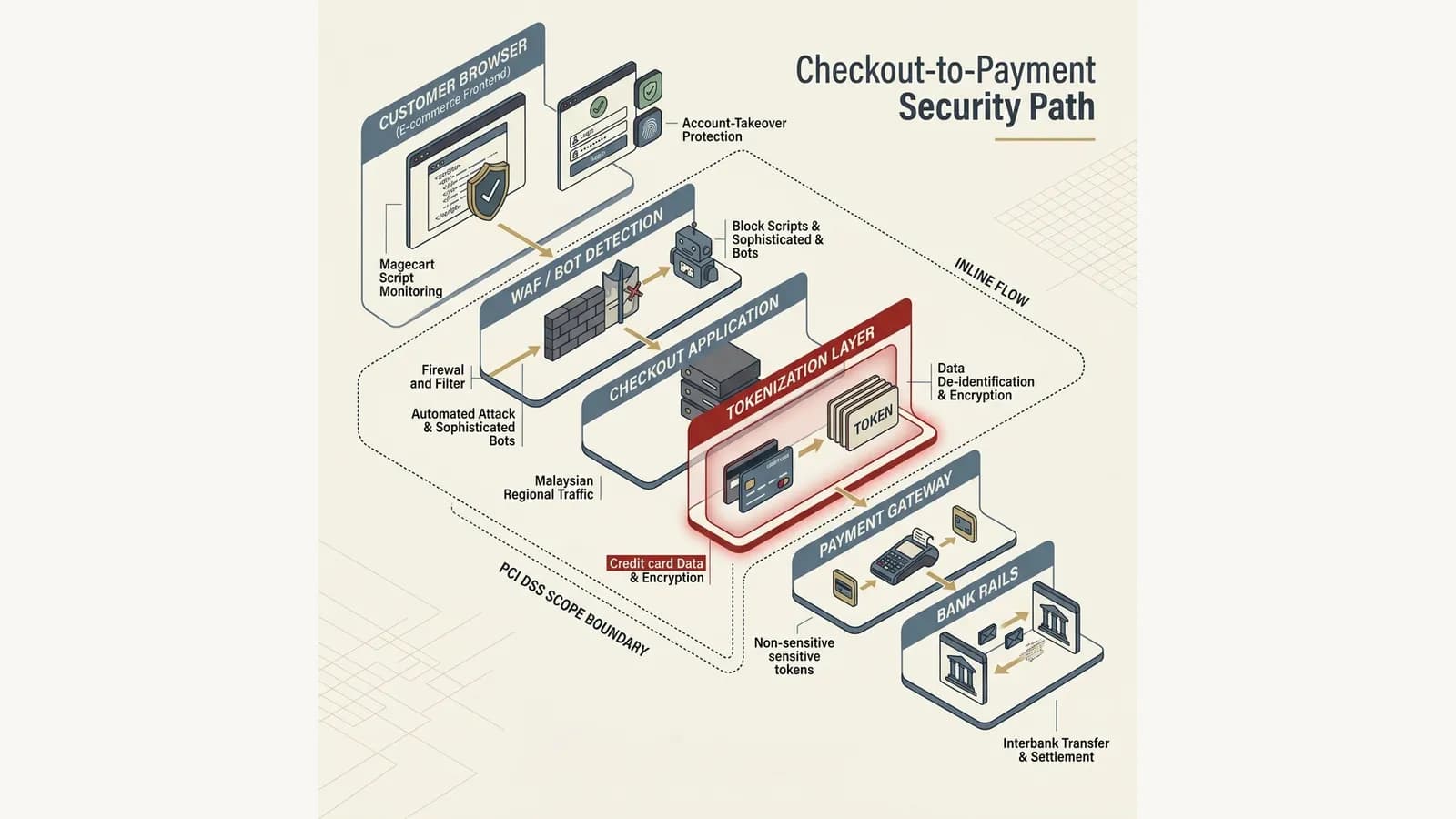
Malaysian online retail sits at the convergence of three attack surfaces that most other industries manage separately: payment card data, customer identity credentials, and high-volume promotional windows that strain fraud controls just as transaction velocity spikes. The threat actor spectrum runs from opportunistic individuals running account-takeover toolkits downloaded from underground forums, through to organised groups with dedicated infrastructure for Magecart script deployment and loyalty-point monetisation.
Magecart-style script injection remains the most structurally dangerous threat for online merchants. An attacker who compromises a third-party JavaScript library loaded at checkout — an analytics tag, a live-chat widget, a payment UX component — can silently exfiltrate card numbers, expiry dates and CVVs as customers type them, entirely outside the payment gateway's visibility. The merchant's bank transaction logs show nothing unusual. The cardholder's statement shows legitimate charges. The exfiltration runs for days or weeks before detection. PCI DSS v4.0 requirements 6.4.3 and 11.6.1 exist specifically to address this attack class, mandating script inventory, integrity verification and continuous tamper monitoring for checkout pages.
Credential stuffing against customer login endpoints is a second structural threat. Data breach marketplaces carry hundreds of millions of Malaysian email and password combinations harvested from prior incidents across e-commerce, ride-hailing, food delivery and social platforms. Automated bot infrastructure replays these credentials against merchant login endpoints at tens of thousands of attempts per hour, probing for account reuse. Where the attack succeeds, the attacker can access stored payment methods, drain loyalty balances, redirect pending deliveries and extract personal data — all within a login session that appears legitimate to session-level monitoring.
Account takeover from successful credential stuffing extends to downstream fraud: orders placed using stored cards with altered delivery addresses, loyalty points converted to gift vouchers sold on secondary markets, and refund abuse where fraudulent return claims exploit high-volume automated approval policies. For merchants running peak campaigns where orders exceed normal volumes by five to ten times, the fraud team's ability to manually review anomalies is saturated — which is exactly the window organised groups exploit.
Business email compromise targeting merchant payout accounts rounds out the primary threat set. Attackers who compromise a finance team email account — frequently via phishing — can redirect supplier payments, payment gateway settlement transfers, or marketplace disbursements to fraudulent accounts. For merchants with high gross merchandise value and daily settlement flows, a single successful BEC event can represent a week's margin. nCrypt maps all of these scenarios through threat modelling, penetration testing and digital risk protection engagements scoped for the Malaysian retail environment.
PCI DSS is the primary technical compliance framework for any Malaysian merchant accepting card payments. The standard is mandated by the card networks (Visa, Mastercard, UnionPay) through acquirer agreements, not by Malaysian statute — but non-compliance triggers acquirer-level consequences including higher interchange rates, mandatory forensic investigations following breach, and potential card acceptance termination. PCI DSS v4.0 introduced the most significant update in a decade, with particular focus on web-skimming defence, stronger authentication requirements and a more risk-based approach to customised implementation. Merchants who structured their compliance programmes around DSS v3.2.1 need to review their checkout script governance and tamper-detection controls against the new version requirements.
The PDPA 2024 amendment adds a statutory layer that PCI DSS does not cover: mandatory breach notification to the Personal Data Protection Commissioner where a breach is likely to cause significant harm to data subjects. An e-commerce operator carrying customer profiles — name, address, mobile number, email, purchase history, device identifiers and payment tokenisation references — across hundreds of thousands of accounts sits firmly within the significant-harm threshold if that data is exfiltrated. The amendment also imposes DPO governance and tightens cross-border data transfer rules, which have direct relevance to Malaysian merchants using offshore cloud infrastructure, cross-border 3PL providers, or international payment processors who process Malaysian customer data outside the country.
For merchants operating stored-value wallets, top-up credit pools or loyalty balances with monetary redemption value, BNM's e-money guidelines under the Financial Services Act 2013 impose an additional security and operational risk management overlay. The security expectations for stored-value systems are substantially more rigorous than for a conventional points programme — covering authentication standards, fraud monitoring, suspicious transaction reporting and system resilience. nCrypt designs e-commerce engagements to help prepare for the PCI DSS, PDPA and BNM regulatory surfaces simultaneously, using evidence that maps to multiple frameworks without requiring separate assessment programmes for each.
The payment flow in a Malaysian online store typically runs: customer selects items → checkout page loads (including third-party scripts) → customer enters or confirms stored payment details → checkout API submits payment request to the gateway → gateway authorises with the issuing bank → confirmation is returned and order is created. Each transition in that chain is a potential attack surface, and understanding which surface you are defending determines which controls are relevant.
At the checkout page layer, the threat is client-side: Magecart-style script injection via compromised third-party JavaScript, misconfigured Content Security Policy headers that permit unauthorised script execution, and browser-level data interception. Defences at this layer are script integrity controls, CSP strictness, and the continuous tamper monitoring now mandated by PCI DSS v4.0. nCrypt's web application penetration testing includes structured client-side analysis of checkout script governance as a core module.
At the API layer, the threats shift to authentication abuse, business logic exploitation and rate-limit bypass. An e-commerce API that does not enforce per-account request limits on its discount validation endpoint, for example, can be probed to identify which promotional codes are valid without triggering fraud alerts. An API that returns full card-last-four and billing address on account profile responses leaks data that assists account takeover social engineering. nCrypt's API penetration testing covers these business logic and data-exposure patterns specifically, not just standard vulnerability classes.
Tokenisation and stored payment methods introduce a further layer: if the token vault or the credential used to call it is compromised, an attacker can initiate payments without ever accessing raw card data. The security of the token vault boundary — access controls, audit logging, credential rotation, and separation from the general application context — is frequently under-reviewed in merchant environments that treat tokenisation as a "solved" problem once the gateway integration is live.
Refund and return flows close the payment attack surface. High-volume e-commerce platforms that automate refund approval above certain value thresholds, or that rely on customer service agent discretion without systematic anomaly flagging, create exploitable policy gaps. nCrypt's fraud operations review maps to this layer — examining refund velocity patterns, approval logic, agent access controls and escalation workflows as part of a broader payment integrity assessment.
Malaysian e-commerce infrastructure typically runs across a mix of cloud providers (AWS, GCP, Azure, and increasingly Alibaba Cloud for cross-border operations), CDN edges (Cloudflare, Akamai), and on-premise or co-location components for payment gateway connectors and logistics system integrations. The cloud surface is not inherently insecure, but it is routinely misconfigured — public S3 bucket exposure of order exports, overly permissive cloud IAM policies granting application service accounts more than the least privilege needed, and unrestricted egress from compute environments that should have no business calling external data endpoints.
Web Application Firewall configuration is frequently treated as a checkbox rather than an ongoing operational discipline. A WAF deployed in detection mode only, with no block rules tuned for the merchant's application behaviour, provides monitoring without protection. Equally, WAF rules that block by simple IP reputation miss the distributed, residential-proxy infrastructure that modern credential-stuffing and scraping operations use. Effective bot detection for e-commerce requires behavioural analysis — session mouse-movement patterns, typing cadence, JavaScript challenge response timing — rather than IP blocklists that sophisticated bot operators rotate around in minutes.
nCrypt's digital risk protection service extends the perimeter outward from the merchant's own infrastructure — monitoring for credential leaks tied to customer accounts, brand impersonation stores running phishing operations, and dark-web exposure of payment data and customer records. For merchants whose reputation is partially built on customer trust in data handling, the ability to detect external threats before they manifest as customer-facing incidents is a material operational advantage.
Malaysian e-commerce revenue is highly concentrated: 11.11 (Hariraya Aidilfitri campaign), 12.12, major payday weekends, and Raya season collectively account for a disproportionate share of annual gross merchandise value for most retail categories. This concentration creates a security problem that is architectural rather than tactical: the infrastructure, fraud controls and monitoring capacity that are adequate for normal-velocity operations are frequently inadequate for the five-to-tenfold traffic and transaction surges of peak periods — and attackers know this.
Campaign security preparation should begin four to six weeks before the peak window. During that window, nCrypt conducts web application and API penetration testing under simulated load conditions, validates WAF rule coverage for known attack patterns relevant to the merchant's platform, reviews fraud detection threshold calibration (rules tuned for normal velocity will generate unacceptable false-positive rates at peak, and merchants frequently loosen them in ways that create fraud exposure), and confirms incident response escalation paths and staff coverage for the campaign period.
In the week before the campaign, the focus shifts from testing to configuration hardening and monitoring readiness — confirming that alerting pipelines are functioning, that security operations contacts are available, and that the merchant's team knows the escalation path if an anomaly is detected during live peak operations. Active penetration testing does not run during the campaign itself. nCrypt's IR retainer arrangement can provide reactive monitoring support during the peak window, with pre-agreed response timeframes for the scenarios most likely to materialise — credential-stuffing surges, loyalty-point drains, and payment anomaly patterns consistent with compromised account activity.
Fraud operations in e-commerce is not a cybersecurity function and not a payments function — it sits at the intersection of both, and is frequently orphaned between teams with neither fully owning it. The consequences of under-investment are systematic: refund abuse runs for months before velocity patterns trigger review, loyalty-point drain accumulates across thousands of low-value individual account compromises that each fall below manual review thresholds, and BEC targeting payout accounts succeeds because the finance team's email security posture is managed separately from the security team's detection infrastructure.
nCrypt's fraud operations review examines the detection and response architecture holistically — mapping data flows from login, checkout, refund and loyalty endpoints into the alerting layer, identifying blind spots where high-velocity low-value fraud can accumulate undetected, and recommending detection logic improvements calibrated for the merchant's transaction patterns rather than generic retail benchmarks. The output is a fraud detection improvement roadmap and a set of monitoring rules the merchant's team can implement within their existing analytics and alerting infrastructure.
Incident response for e-commerce requires preparation that generic IR frameworks do not address: PCI DSS breach reporting obligations to the card networks and acquirer, PDPA 2024 notification to the Personal Data Protection Commissioner, customer communication at scale for account takeover events, and coordination with payment gateway and issuing bank contacts for card-compromise scenarios. nCrypt's e-commerce IR retainer pre-positions these obligations, pre-negotiates response timeframes, and ensures that the first hour of an incident is spent on containment rather than on identifying who to call.
Scope scoping, control gap analysis, evidence pack assembly and independent assessment support mapped to PCI DSS v4.0 — including the new script integrity and tamper monitoring requirements.
Full OWASP-aligned pentest of your checkout, account, admin and API surfaces. Client-side script analysis, Magecart injection vectors and CSP hardening included.
REST and GraphQL API security assessment covering authentication, rate limiting, business logic abuse, mass assignment and sensitive data exposure across your product, payment and loyalty APIs.
External monitoring for credential leaks, brand impersonation, phishing store clones and dark-web exposure of your customer data — with takedown support where needed.
Breach notification runbook, DPO governance design, cross-border transfer review and data minimisation for customer profiles, purchase histories and payment instrument storage.
Pre-positioned incident response for Magecart compromise, mass account takeover, loyalty fraud, ransomware and BEC. Campaign-period standby arrangements available.
Yes, in most cases — though the scope depends on how your checkout is structured. Using a hosted payment page or tokenised gateway reduces PCI DSS scope significantly, but it does not eliminate it entirely. Your systems still handle card data at some point in the initiation flow, and you must demonstrate controls over that surface. PCI DSS v4.0, effective March 2024, introduced more prescriptive requirements around web-skimming (Requirement 6.4.3 and 11.6.1) that explicitly target Magecart-style script injection against checkout pages. Merchants routing through a payment gateway still need to complete the appropriate Self-Assessment Questionnaire and demonstrate control over their cardholder data environment boundary. nCrypt helps prepare for PCI DSS scoping, gap assessment, evidence assembly and the independent Security Assessor engagement where required.
Magecart refers to a class of client-side supply chain attacks where malicious JavaScript — injected into a checkout page via a compromised third-party script, a vulnerable CMS plugin, or a direct breach of the merchant's codebase — silently captures payment card data as the customer types it and exfiltrates it to an attacker-controlled server. The merchant's payment gateway never sees the compromise; neither does the bank. The attack surface is the browser session, not the server transaction. Malaysian online retailers using WooCommerce, Magento, OpenCart or custom storefronts are exposed through outdated plugins, misconfigured Content Security Policy headers, and poorly governed JavaScript tag management. PCI DSS v4.0 requirements 6.4.3 and 11.6.1 directly address this attack class and mandate script inventory, integrity verification and tamper monitoring for checkout pages. nCrypt's web application penetration testing maps to these requirements and includes client-side script analysis as a core module.
Credential stuffing is the automated replay of username-password pairs leaked from unrelated breaches — data breach marketplaces carry hundreds of millions of Malaysian email-password combinations from prior incidents across forums, delivery apps, ride-hailing platforms and retail sites. Threat actors acquire these lists and systematically test them against an e-commerce login endpoint using distributed bot infrastructure. Where customers reuse passwords, the attacker logs in, drains loyalty points, modifies shipping addresses, places high-value orders using stored payment methods, and extracts saved card data. A single successful account takeover campaign can affect thousands of accounts before rate-limiting detects the pattern. nCrypt's bot detection and API penetration testing helps prepare for this attack class, covering login endpoint hardening, anomaly detection design, and CAPTCHA resistance testing.
The PDPA 2024 amendment introduces mandatory breach notification — where a personal data breach is likely to result in significant harm to data subjects, the Personal Data Protection Commissioner must be notified within a specified timeframe. For an e-commerce operator carrying customer profiles including names, addresses, payment instrument references, purchase histories and device fingerprints across potentially hundreds of thousands of accounts, the threshold for significant harm is low. The amendment also imposes a Data Protection Officer appointment obligation on data controllers and processors meeting prescribed criteria, and tightens rules on cross-border personal data transfers — relevant to operators using offshore cloud infrastructure, third-party logistics providers or cross-border payment processors. PDPA compliance for e-commerce involves data minimisation for the customer profile, breach notification runbook preparation, and DPO governance. nCrypt's PDPA readiness work maps to these requirements.
If your e-commerce platform holds a stored-value balance on behalf of customers — whether a gift wallet, a top-up credit pool, or a loyalty-point system with redemption value — BNM's e-money and stored-value guidelines may apply depending on the nature of the value stored and the operator's licensing position. Stored-value features attract regulatory interest from BNM under the Financial Services Act 2013, and the associated security controls are substantially higher than for a points-only loyalty programme. Even where BNM licensing is not triggered, stored-value balances are a high-value target for account-takeover and loyalty-fraud attacks. nCrypt helps prepare for the security control assessment of stored-value systems — covering authentication, session management, transaction monitoring, and fraud-alert design.
Penetration testing and vulnerability scanning are not run during active peak sale periods. The correct approach is a pre-campaign security window — ideally 4 to 6 weeks before the campaign — during which web application and API testing is completed, remediation is verified, and WAF rules and bot detection thresholds are tuned. In the week before the campaign we typically deliver a configuration review and threat-monitoring readiness check rather than active testing. During the campaign, nCrypt can provide reactive monitoring support under an IR retainer arrangement, with agreed escalation paths and response timeframes. The goal is that the security work is finished before the campaign starts, not running in parallel with peak revenue operations.
Refund abuse is a category of operational fraud where the attacker exploits the merchant's own refund or return process rather than the payment system itself. Common patterns include claiming non-delivery on orders that were received, returning counterfeit or damaged goods in place of genuine items, exploiting automated refund approval logic on high-volume platforms, and social engineering customer service agents with fabricated order evidence. Unlike payment fraud (which primarily harms the issuing bank), refund abuse directly impacts merchant revenue and is increasingly systematic — organised groups run playbooks against specific merchant refund policies. Defending against refund abuse involves a combination of order anomaly detection, refund-velocity monitoring, and policy hardening — areas nCrypt addresses through fraud operations review and threat modelling.
An e-commerce IR retainer pre-positions incident response capability for the scenarios most likely to affect a Malaysian online retailer: payment card data exfiltration via Magecart-style injection, mass account takeover of customer accounts, loyalty point or gift wallet fraud, ransomware impacting order management and fulfilment systems, and BEC targeting merchant payout accounts. The retainer includes pre-agreed response timeframes, offline forensic tooling sized for the merchant's stack, a regulatory notification matrix covering PDPA 2024 and PCI DSS breach reporting obligations, and playbooks for customer communication. For merchants operating on peak-campaign-dependent revenue models, the retainer also includes a campaign-period standby arrangement.
30-minute scoping call with a payment-security-credentialed consultant. PCI DSS v4.0, PDPA 2024, WAF hardening, and peak-campaign readiness.
Request E-Commerce Scoping CallShare your scope. We'll respond within 24 hours.
Fill out the form and we'll get back to you within 24 hours.