Loading...
Loading...
Cybersecurity for Malaysian insurers, takaful operators and reinsurers. RMiT alignment, PDPA 2024 readiness, claims-fraud ML defence, and an IR retainer that understands the difference between a policy administration outage and an actuarial data breach.
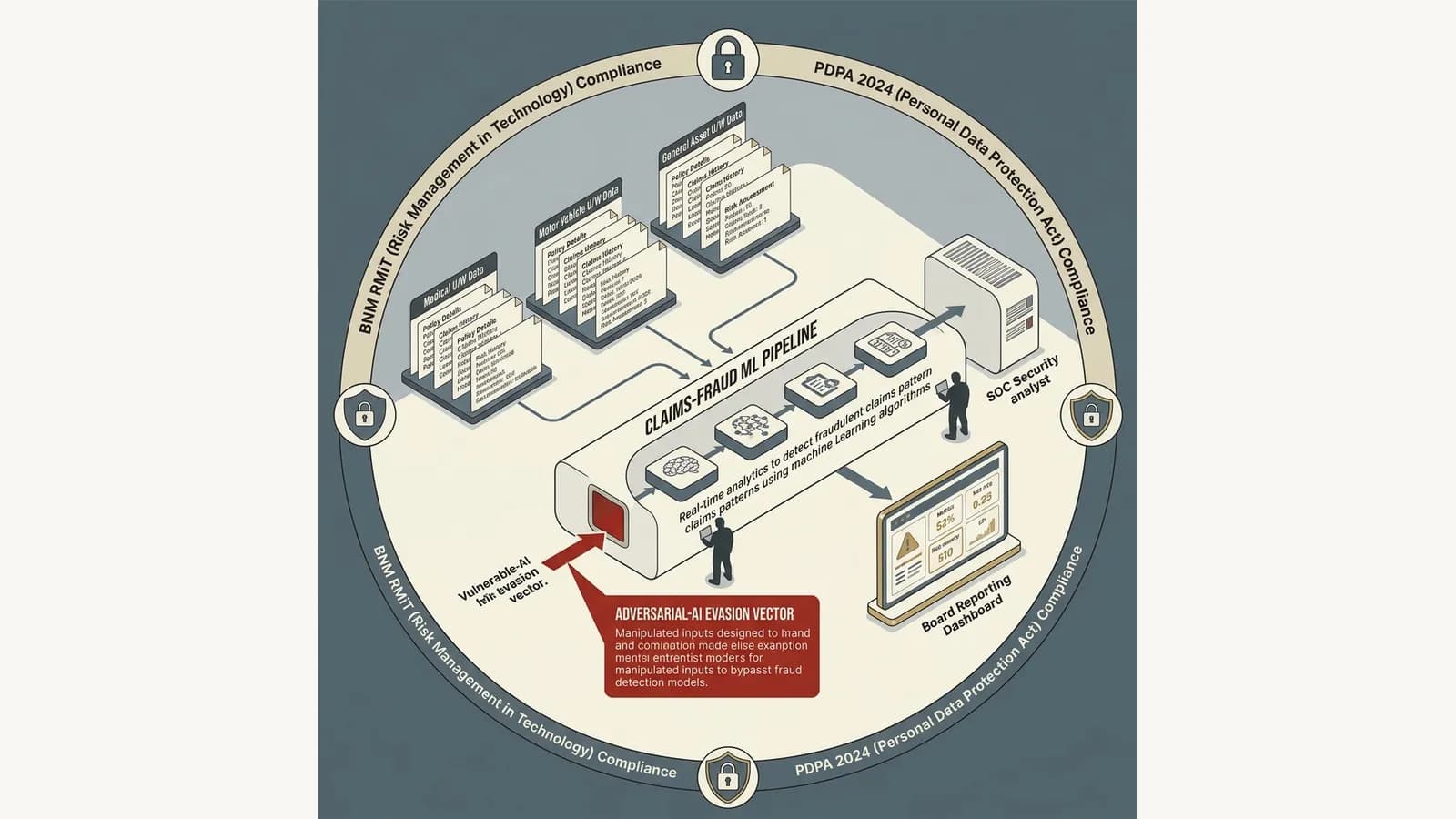
An insurer holds the most sensitive personal data set of any commonly occurring corporate entity. Life and health insurers carry medical histories, treatment records, prescription data and family medical context. Motor insurers carry vehicle history, driving record and accident histories. General insurers carry asset valuations and home-security context. Layered on top of all of that is full identity, banking and payment instrument data plus, where bancassurance applies, the cross-product profile that links insurance to banking products. The depth of this data set is what makes an insurance breach so disproportionately consequential per record exposed.
The threat actor stack is bifurcated. Financially motivated organised crime targets insurers for the data set itself — sold for synthetic identity fraud, medical identity theft, and targeted phishing. State-aligned actors have demonstrated interest in insurer data sets for population-scale intelligence value, with the 2015 Anthem breach (78.8 million records) the canonical example, attributed publicly to a state-aligned threat actor. Insider abuse — particularly within the agent and broker network — is a third and persistent threat surface that mature insurers spend significant detection investment on.
nCrypt's insurance practice is anchored on three principles — RMiT-grade controls discipline, PDPA 2024 breach-readiness, and claims-fraud ML defence. We deliver these through pentest, IR retainer and ongoing assurance services scoped for insurer realities.
BNM regulates Malaysian insurers and takaful operators under the Financial Services Act 2013 and the Islamic Financial Services Act 2013, with capital adequacy under the Risk-Based Capital Framework for Insurers and the equivalent takaful framework. Operational risk — within which cyber sits — is a capital charge category. RMiT (Risk Management in Technology) applies to insurers as financial institutions, imposing detailed cyber risk management, cyber resilience and cyber operations centre obligations. PDPA, particularly the 2024 amendment, adds the data-protection overlay with mandatory breach notification, Data Protection Officer appointment and tightened cross-border transfer rules.
Layered on top of the BNM and PDPA regimes is the Cyber Security Act 2024, which permits NACSA to designate financial-sector entities as National Critical Information Infrastructure. Major insurers and takaful operators sit firmly within the credible NCII candidate set. NCII designation imposes additional risk assessment, audit, incident reporting and licensed cybersecurity service provider procurement obligations on top of the BNM regime.
nCrypt designs insurer engagements to satisfy the BNM, PDPA and NACSA regimes simultaneously — single set of evidence, multiple regulatory uses.
Insurers have invested heavily in machine learning for claims fraud triage. The economics are compelling — even a small percentage point improvement in fraud detection on a high-volume motor or health book is materially profitable. The unintended consequence is that the fraud-detection model is itself a high-value target. Adversaries who understand the model's decision surface can craft claim submissions that score below the flag threshold (evasion attack), reverse-engineer training set patterns to inform fraud at scale (model inversion), or — in the most sophisticated attacks — influence the model's labelled feedback loop to slowly degrade decision quality (training-data poisoning).
nCrypt's adversarial AI assessment for insurers covers structured input fuzzing against the live or staging model, training-data integrity review, model-monitoring design (drift detection, decision-distribution monitoring), and the access-control surface around the model itself (who can re-train, who can label, who can deploy). This is a young discipline globally, and one that Malaysian insurers should not wait for the regulator to mandate before adopting.
BNM RMiT cyber risk management, cyber resilience and cyber operations centre gap assessment, scoped for insurers and takaful operators.
Adversarial input testing, training-data integrity review, model inversion and evasion testing of claims-fraud machine learning pipelines.
Breach notification runbook, DPO governance, cross-border transfer review, and Article 7-aligned data minimisation for the underwriting and claims data sets.
Scenarios covering policyholder data exfiltration, agent credential abuse, claims-fraud model compromise, BEC, and ransomware on policy-admin and claims systems.
Banks and insurers share a regulator (BNM) and overlap heavily on PDPA obligations and operational risk discipline. The insurer attack surface differs in three structural ways. First, data depth — an insurer holds not just identity and payment data but the underwriting file (medical history for life and health, vehicle and driving history for motor, asset valuations for general), making the breach impact disproportionate per record. Second, the claims process is inherently fraud-adversarial — an insurer is one of the few financial institutions whose customers are routinely incentivised to lie, which has driven heavy investment in claims-fraud machine learning and a corresponding new attack surface (model evasion, training data poisoning). Third, the agent and broker network is large, distributed and incentive-driven — a third-party access surface that banks generally do not carry to the same degree.
BNM's risk frameworks for insurers and takaful operators — including the Risk-Based Capital (RBC) Framework for Insurers and the Risk-Based Capital Framework for Takaful Operators — treat operational risk (which includes cyber) as a capital charge category. RMiT, BNM's Risk Management in Technology policy document, applies to financial institutions including insurers, with explicit cyber risk management, cyber resilience and cyber operations centre obligations. PDPA — particularly the 2024 amendment — adds the data-protection overlay including the new mandatory breach notification and Data Protection Officer appointment obligations. The compliance map for a Malaysian insurer is RMiT (cyber controls) plus PDPA 2024 (data protection) plus the relevant capital framework (operational risk capital), with sector-specific guidance from BNM where issued.
Insurers increasingly use machine learning to triage claims — flagging anomalies for adjuster review or, in some workflows, auto-approving low-risk claims. Adversarial AI is the discipline of intentionally crafting inputs (claim narratives, photographs, documentary evidence) designed to evade or manipulate the model. Concrete examples include evasion attacks (a synthetic claim engineered to score below the fraud-detection threshold), model inversion (extracting training-set claim patterns to reverse-engineer the model's logic), and training-data poisoning where an adversary with influence over a feedback loop slowly drifts model decisions. nCrypt assesses ML claims pipelines for these failure modes — adversarial input testing, training-data integrity controls, and model-monitoring design.
The PDPA 2024 amendment introduces three obligations of immediate relevance to insurers. (1) Mandatory breach notification — a personal data breach likely to result in significant harm must be notified to the Personal Data Protection Commissioner within a specified timeframe and, where appropriate, to the affected data subjects. For insurers carrying medical and financial data on tens of thousands of policyholders, the threshold for significant harm is low. (2) Data Protection Officer appointment becomes a positive obligation for data controllers and processors meeting prescribed criteria. (3) Cross-border personal data transfer rules tighten, with relevance to insurers using offshore reinsurers, claims processors or cloud providers. Insurers must update breach response runbooks, contractual cross-border arrangements and DPO governance to align.
An insurer IR retainer overlays the standard incident response capability with insurer-specific scenarios — claims-fraud model compromise, mass-policyholder-data exfiltration, agent-network credential abuse, BEC against premium and claims funds flow, and ransomware impacting policy-administration and claims-management systems. The retainer also pre-arranges the regulatory notification matrix — BNM under RMiT incident reporting, the Personal Data Protection Commissioner under PDPA 2024, and where applicable NACSA under the Cyber Security Act 2024 (insurers are credible NCII candidates given the financial sector designation). Pre-positioned credentials and offline forensic tooling are sized for an insurer's typical estate — policy admin, claims, agent portal, customer self-service, data warehouse, ML pipeline.
30-minute scoping call with a financial-services-credentialed consultant. RMiT, PDPA 2024, NACSA and adversarial AI alignment.
Request Insurance Scoping Call