Loading...
Loading...
Cybersecurity for Malaysian port operators, freight forwarders, 3PLs and the shippers they serve. Built on the lessons of NotPetya — segmented networks, hardened third-party connections, and an IR retainer that understands EDI as well as it understands SIEM.
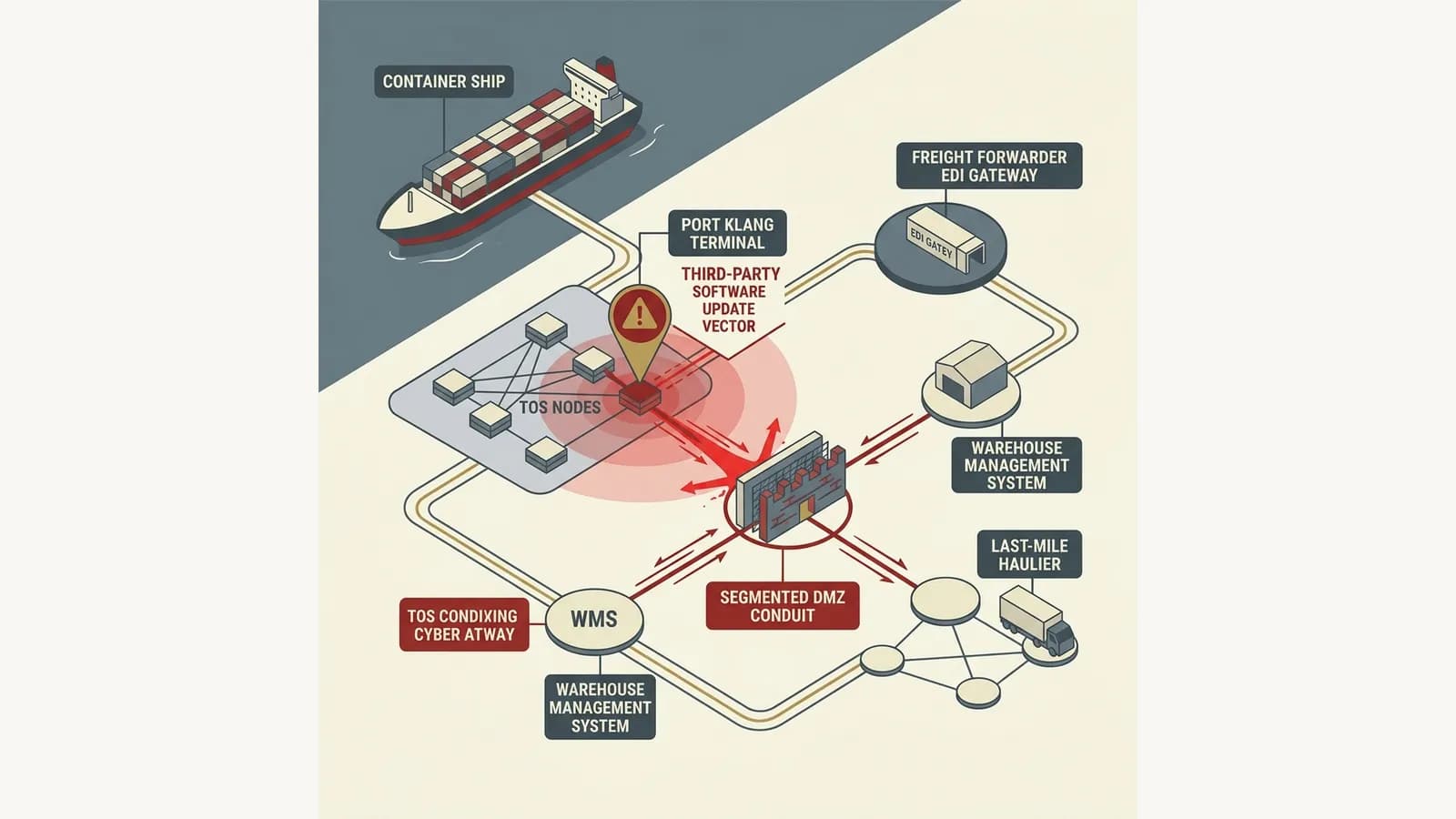
On 27 June 2017, NotPetya — a destructive wiper masquerading as ransomware — encrypted approximately 49,000 endpoints across A.P. Moller-Maersk in roughly seven minutes. The propagation vector was a backdoored update to M.E.Doc, a Ukrainian tax accounting application; the lateral-movement vector was the EternalBlue SMBv1 exploit. Maersk terminal operations stopped at 76 ports globally. Container throughput at major terminals took weeks to restore. The publicly reported financial impact was on the order of USD 250-300 million.
The Maersk recovery story is now famous in incident response circles. The only Active Directory domain controller that survived NotPetya was a machine in Ghana that had been offline during a power cut at the moment of detonation. That machine became the seed for the global Active Directory rebuild. Three operational lessons emerge for Malaysian logistics operators. First, the attack vector was a third-party software supply chain — a vendor whose security posture Maersk had no operational visibility into. Second, lateral movement was effectively unimpeded across a flat global network — segmentation would have constrained the blast radius. Third, the recovery was bounded by backup discipline and identity-system resilience, not by perimeter defence.
nCrypt's logistics methodology is built on these three lessons — assume the third party will be the entry point, design segmentation that constrains blast radius, and harden backup and identity recovery as first-class controls.
Terminal Operating Systems controlling yard moves, EDI integration with customs and shippers, vessel traffic systems, OT for cranes and straddles, and the corporate IT estate — all in one operator. Malaysian players: Port Klang, Penang Port, Johor Port, Kuantan Port, and the East Malaysian terminal estate. Risk: cascading port-throughput impact and national supply chain consequence.
Booking platforms, customer portals, customs broker integrations, warehouse management systems, transport management systems and a long tail of partner EDI connections. Risk: business email compromise on funds flow, cargo diversion via manipulated booking data, ransomware impacting warehouse and transport operations.
Manufacturers and traders whose supply chains depend on the operators above. Risk: cargo theft and smuggling concealment via booking-system compromise, BEC fraud impersonating forwarders, and direct dependency on third-party operator availability. Mitigation is a TPRM programme that takes the supply chain seriously.
Tiered due diligence, contractual security clauses, ongoing monitoring and clean-exit procedures across your supplier base.
Zone-by-zone scoping across corporate IT, TOS environment, EDI gateways and the OT estate. Hazard-gated active testing.
Guaranteed acknowledgement SLA, pre-positioned credentials, scenarios covering TOS compromise, EDI integrity loss, BEC and OT incidents.
Authentication, integrity, monitoring and abuse-detection design for container booking, EDI gateways and partner-facing logistics platforms.
On 27 June 2017, NotPetya — a destructive wiper masquerading as ransomware, propagating via a backdoored Ukrainian tax software update and the EternalBlue SMBv1 exploit — encrypted approximately 49,000 Maersk endpoints in seven minutes. Maersk's terminal operations stopped at 76 ports worldwide, with global container throughput materially impacted for weeks. The recovery cost was reported by Maersk at approximately USD 250-300 million. Three lessons for Malaysian operators: (1) the propagation vector was a software supply chain — a third-party tax application update that nobody at Maersk had authority over; (2) once inside, lateral movement via SMBv1 was effectively unimpeded across a flat global network; (3) the only surviving Active Directory domain controller was an offline machine in Ghana that had been disconnected during a power cut. Backup discipline mattered more than perimeter defence.
Port operators sit at a five-way intersection of attack surfaces — terminal operating systems (TOS) controlling container yard moves, customs and EDI integration with national authorities, vessel traffic systems and AIS, OT for cranes and straddle carriers, and the corporate IT estate. The 2017 Maersk incident demonstrated impact at terminal operations layer. The 2020 Mediterranean Shipping Company (MSC) outage and the 2021 Port of Houston cyber incident demonstrated the same surface continues to be probed. Malaysian ports — Port Klang, Penang Port, Johor Port, Kuantan Port and the East Malaysian terminal estate — share these surfaces. nCrypt scopes port engagements zone-by-zone, with explicit segmentation review between corporate IT, the TOS environment, and the OT estate.
Supply chains are, by definition, third-party-heavy — every shipper, every freight forwarder, every customs broker, every haulier and every warehouse operator is a third party to somebody. TPRM is the discipline of assessing, contracting, monitoring and exiting those third parties on a security footing — not just commercially. A robust TPRM programme covers (1) tiered due diligence pre-contract scaled to the criticality of the third party, (2) contractual security clauses including incident notification, audit rights and data return on exit, (3) ongoing monitoring including periodic re-assessment and continuous monitoring for high-criticality vendors, and (4) clean exit procedures. nCrypt designs and implements TPRM programmes for Malaysian shippers, manufacturers and 3PLs.
Container booking systems — including the EDI gateways that exchange shipping instructions, bill-of-lading data and customs declarations between shippers, carriers, forwarders and ports — are a high-value target for two distinct threat actor profiles. Financially motivated actors target booking data to enable cargo theft (diverting a container by manipulating discharge instructions) or to defraud shippers via business email compromise impersonating freight forwarders. Smuggling networks target booking data to enable narcotics or contraband concealment in legitimate shipper containers — the so-called rip-on/rip-off technique used at major container ports globally. The 2018-2020 attacks against Antwerp port systems are a documented example. Malaysian operators should treat their TOS, EDI gateways and booking platforms as Tier-1 critical systems for cybersecurity scoping.
Yes. The logistics IR retainer is structurally similar to our enterprise retainer — guaranteed acknowledgement SLA, pre-positioned credentials, offline forensic tooling — but is overlaid with logistics-specific scenarios. These include TOS compromise with cascading yard-operations impact, EDI gateway data integrity loss, business email compromise on shipper-forwarder-carrier funds flow, ransomware impacting warehouse management systems, and incidents touching the OT estate (cranes, straddles, conveyors). The retainer also covers the regulatory notification matrix unique to logistics — customs, MOT, port authority and, where applicable, NACSA under the Cyber Security Act 2024.
30-minute scoping call. NotPetya-aware methodology. TPRM, port pentest and IR retainer scoped for logistics realities.
Request Logistics Scoping Call