Loading...
Loading...
Cybersecurity for Malaysian renewable operators, Independent Power Producers, energy storage businesses, and EV charging network operators. OT-literate assessments, Suruhanjaya Tenaga alignment, and Cyber Security Act 2024 readiness for an energy sector in rapid transition.
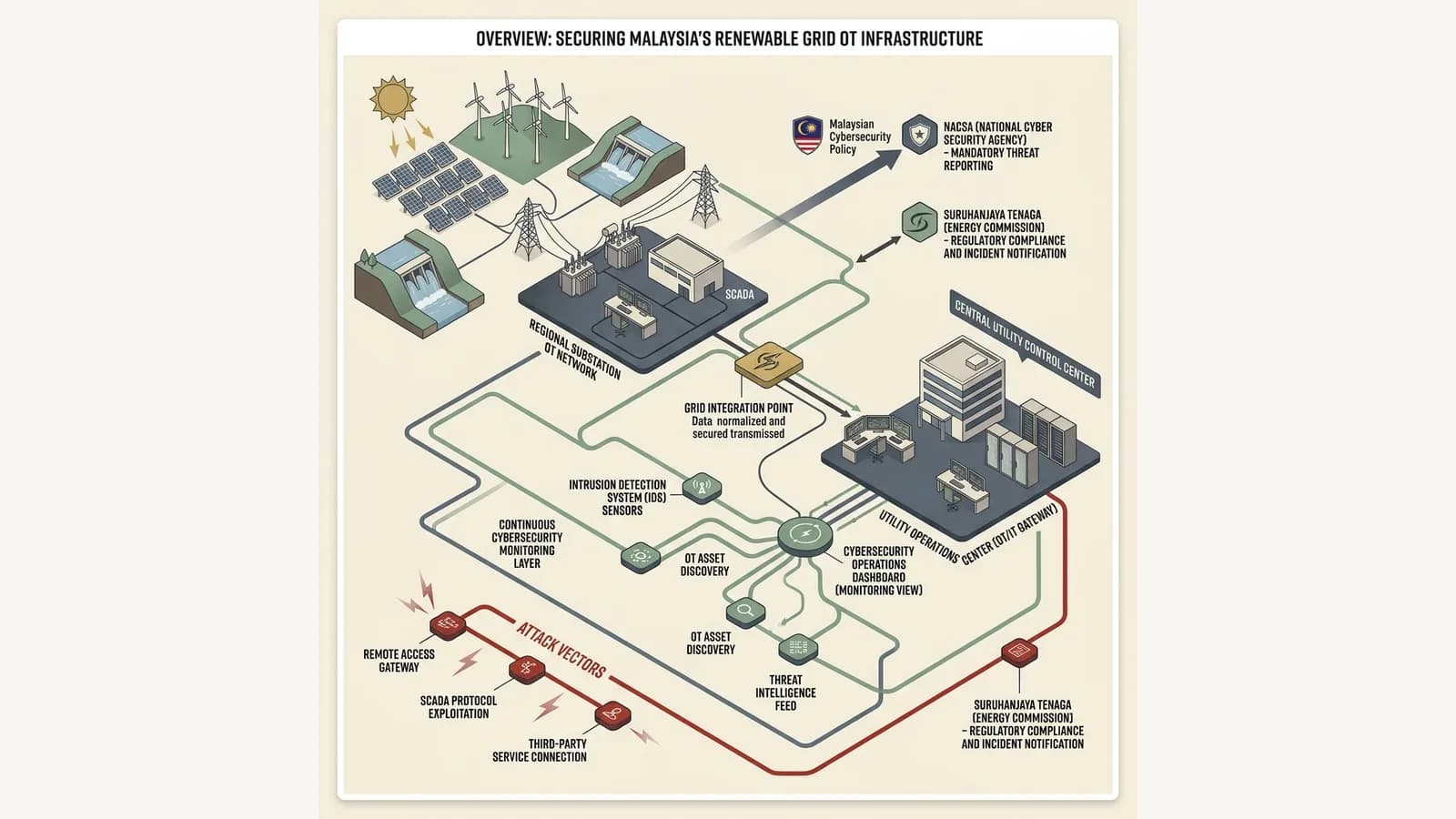
nCrypt serves three distinct segments of the Malaysian energy landscape, and each segment warrants a dedicated cybersecurity approach. The Utilities & Power page covers large-scale grid operations — TNB-adjacent distribution network management, high-voltage transmission corridors, and the established NCII-regulated environment where regulatory obligations and security maturity are already significant. The Oil & Gas page addresses upstream exploration and production, offshore platform OT environments, pipeline SCADA, and downstream refining — a hydrocarbons-specific OT and process safety world with PETRONAS and international operator frameworks in scope.
This page covers a third and rapidly growing segment: renewable energy operators running solar, wind, hydroelectric mini-run-of-river, and biomass generation assets; Independent Power Producers managing grid-connected portfolios; energy storage system operators integrating battery energy storage at grid scale or behind the meter; businesses participating in the Solar Accelerated Transition Action Programme (ATAP) as aggregators or virtual power plant operators; and EV charging network operators whose infrastructure increasingly connects to the distribution grid.
This segment is in energy transition. Assets are being commissioned faster than security programmes are being built. Remote monitoring connectivity is assumed from day one. Vendor access is embedded in supply contracts. And regulatory expectations from Suruhanjaya Tenaga and NACSA are growing to match the commercial significance of the sector. That combination — rapid growth, embedded connectivity, and rising regulatory pressure — is exactly where nCrypt focuses.
The threat landscape for renewable energy operators sits at the intersection of IT and OT. Most renewable operators have built strong commercial IT capabilities — CRM, billing, ERP, remote dashboards — but have inherited OT environments from equipment vendors with minimal security baseline. That gap is the primary attack surface.
Renewable IPPs operate billing systems, generation asset management platforms, finance and payroll infrastructure, and reporting environments that are attractive ransomware targets independent of any OT exposure. A ransomware event encrypting the back-office does not necessarily trip offline generation assets — but it destroys billing continuity, production reporting, and contractual PPA (Power Purchase Agreement) compliance evidence. Off-grid backups and tested recovery runbooks are rare in the sector. One well-documented pattern targets the O&M contractor network as a lateral path into the IPP back-office, exploiting the trusted but under-monitored third-party relationship.
Commercial-scale solar and wind installations use IP-connected inverter management systems and SCADA platforms to control generation, monitor asset health, and communicate with grid interface protection systems. Inverter management interfaces — particularly those using vendor cloud relay platforms — frequently lack multi-factor authentication and expose control functions over standard web protocols. A motivated adversary with access to an inverter management system can curtail generation output, modify protection relay settings, or — in the most consequential scenario — cause an uncontrolled disconnect event at the grid interface. The 2022 Nordex and 2023 ABO Wind incidents in Europe demonstrated that OT-connected renewable operators are active targets, not hypothetical victims.
Virtually every renewable generation asset is sold with vendor remote monitoring as a contracted deliverable. Inverter manufacturers, BESS suppliers, and EPC contractors maintain persistent remote access for performance tracking, warranty management, and firmware deployment. These vendor platforms routinely use shared credential pools across multiple client sites, lack session timeout controls, and provide no audit trail visible to the asset operator. A compromise of the vendor platform — or a malicious action by a vendor staff member — can affect multiple renewable operator sites simultaneously. nCrypt has observed vendor access tunnels left active years after commissioning contracts concluded, with no mechanism for the operator to revoke or monitor sessions.
EV charging operators carry a distinct fraud and abuse surface. The OCPP interface between the charge point management system and individual chargers is increasingly understood as an attack surface — published research has demonstrated remote charger takeover, session billing manipulation, and denial-of-service via malformed OCPP messages against unpatched charger firmware. Beyond OT, the customer-facing billing and account portal presents credential stuffing risk, and loyalty or top-up payment APIs are targets for transaction fraud. As Tenaga Nasional Berhad and grid operators develop smart charging programmes, EV charging operators will face grid interface security obligations that currently apply only to larger generation assets.
Battery energy storage systems deployed at grid scale or in commercial and industrial (C&I) applications typically include battery management systems (BMS) with IP-connected monitoring interfaces. These interfaces are designed for remote performance visibility and alarm management, but are frequently deployed with vendor-default credentials, no firmware update cadence, and minimal network segmentation from corporate IT. A compromised BMS can mask degrading battery health, interfere with charge and discharge scheduling, or — in systems with active grid frequency response capability — interfere with grid stabilisation functions. The proliferation of IoT-grade hardware across energy storage deployments creates a tail-risk exposure that operators and their insurers are beginning to price.
Malaysian renewable energy operators sit at the intersection of three regulatory regimes. Suruhanjaya Tenaga (ST) oversees the electricity supply industry under the Electricity Supply Act 1990, administers generation licences and grid connection approvals, and — as the designated sector lead agency under the Cyber Security Act 2024 — coordinates with NACSA on NCII identification and sector guidance for the energy sector. ST's technical licence conditions and grid code requirements are progressively incorporating cybersecurity expectations, particularly for operators with grid-affecting control systems.
The Cyber Security Act 2024 creates a statutory NCII framework with annual risk assessment obligations, biennial independent audit requirements, mandatory incident reporting to NACSA via the sector lead, and a licensed cybersecurity service provider procurement obligation for designated NCII operators. While large utilities and transmission operators face near-certain designation, the risk-based NCII identification methodology means that renewable IPPs with meaningful grid-connected capacity, battery storage operators with grid stability roles, and energy aggregators are credible candidacy scenarios as the sector grows in commercial significance. Proactive Cyber Security Act readiness — building the risk assessment, incident reporting, and audit-ready control posture before designation — is substantially less disruptive than a reactive programme triggered by a NACSA determination.
The ATAP context matters here. The Solar Accelerated Transition Action Programme, effective from 1 January 2026, accelerates Malaysia's transition from NEM (Net Energy Metering) to a new export tariff and capacity framework. As ATAP drives a rapid expansion of grid-connected renewable capacity — particularly commercial and industrial rooftop, ground-mounted utility solar, and aggregated virtual power plant portfolios — the aggregate cybersecurity risk of the sector grows. ST and NACSA are both watching this expansion and both have the regulatory instruments to raise cybersecurity expectations for participants.
PDPA 2024 applies directly to renewable energy retailers, EV charging operators, and any energy business maintaining customer billing relationships. The mandatory breach notification obligation, DPO appointment requirement, and cross-border transfer restrictions are particularly relevant for businesses using foreign-hosted monitoring platforms, offshore cloud providers, or overseas billing systems. Energy consumption and EV session data are sensitive categories of personal data that warrant the heightened protection the 2024 amendments require.
A renewable energy operator typically operates across five distinct security zones, each with its own risk profile, asset inventory, and control requirements. Effective cybersecurity requires a zone-by-zone assessment rather than a single perimeter approach.
Inverter management systems, SCADA historian, protection relay panels, site communications infrastructure, data loggers, and generation control servers. Highest consequence if compromised; requires passive discovery, architecture review, and targeted active testing scoped to avoid generation curtailment.
Vendor cloud monitoring platforms, MQTT and REST telemetry gateways, remote desktop and VPN access channels maintained by EPC contractors and O&M providers. The primary inherited risk surface — nCrypt maps every active remote access path and tests access controls, session management, and network segmentation for each.
PPA invoicing, generation reporting, payroll, accounts payable, and regulatory filing systems. The ransomware target zone — typically IT infrastructure with Active Directory, Microsoft 365, and accounting software. Business continuity and backup integrity are the primary controls assessed here.
Protection relays at the connection boundary, grid code compliance systems, active power and reactive power control interfaces, and — for larger operators — grid frequency response or ancillary services systems. Increasingly subject to ST technical oversight; requires collaboration between IT security and licensed electrical engineering.
Charge point management system, OCPP gateway, customer account portal, payment and billing API integrations, and — for smart charging implementations — grid-connected demand response interfaces. Assessed using a combined IoT penetration test and API security assessment methodology.
Architecture review, passive OT discovery, and targeted active testing of inverter management, BESS, SCADA, and grid interface systems. Mapped to IEC 62443 zones and ST audit expectations.
Enumeration and testing of all active vendor remote access channels, session controls, network segmentation, and firmware update integrity. Governance recommendations for time-bound and supervised vendor access.
OCPP protocol testing, charger management system access controls, customer portal API assessment, billing and payment data exposure, and grid interface segmentation review for EV charging operators.
Risk assessment framework, incident reporting capability design, audit-ready control documentation, and sector lead engagement preparation for renewable operators approaching NCII candidacy.
Breach notification runbook, DPO governance, cross-border transfer controls, and data minimisation review for energy retailers, aggregators, and EV charging operators holding customer personal data.
Corporate IT network assessment covering remote monitoring portals, billing systems, SCADA historian connectivity, and Active Directory exposure for renewable operator back-office environments.
nCrypt's industry coverage segments the Malaysian energy landscape into three distinct verticals to give each sector the specificity it deserves. The Utilities & Power page covers large-scale TNB-adjacent grid operations, distribution networks, and the high-voltage transmission environment where NACSA NCII status is well-established and the regulatory regime is mature. The Oil & Gas page covers upstream exploration and production, offshore platform OT, pipeline SCADA, and downstream refining — a petrochemical and hydrocarbons environment with its own risk profile around PETRONAS and international operator standards. This Energy page covers a third and increasingly important segment: renewable energy operators, Independent Power Producers, energy storage system operators, grid-edge technology businesses, and EV charging network operators. These entities are growing rapidly under Malaysia's energy transition agenda, are increasingly grid-connected at meaningful capacity, and face a cybersecurity environment that combines IT threats (billing, customer data, remote monitoring portals) with OT threats (inverter control systems, battery management, SCADA at generation sites) at a scale that most have not historically planned for.
The Cyber Security Act 2024 empowers NACSA to designate entities as National Critical Information Infrastructure (NCII) operators across eleven designated sectors, one of which is the energy sector. The Act does not define a minimum capacity threshold in the legislation itself — NCII designation is a risk-based regulatory determination by NACSA in consultation with the relevant sector lead. For energy, Suruhanjaya Tenaga acts as the sector lead agency. As the Solar Accelerated Transition Action Programme (ATAP) expands grid-connected renewable capacity and aggregated renewable portfolios grow in commercial significance, the probability of NCII candidacy for larger IPPs and aggregators increases. nCrypt helps renewable operators prepare for potential designation — conducting the risk assessments, establishing the incident reporting capability, and building the audit-ready security posture that NCII obligations require, before designation forces a reactive programme. Using language that maps to rather than implies legal certainty: the ATAP-driven capacity growth environment makes proactive Cyber Security Act readiness a sensible investment for any renewable operator above 10 MW of grid-connected generation.
Renewable generation sites present a distinct OT risk profile compared with conventional power plants. The key exposures are: inverter and power conversion control systems that are increasingly IP-connected and remotely managed, often via vendor cloud platforms or MQTT-based telemetry with minimal authentication hardening; battery energy storage systems (BESS) whose battery management systems (BMS) are routinely internet-reachable for remote performance monitoring; remote monitoring gateways and data loggers that aggregate site-level telemetry and are often installed with vendor-default credentials; grid interface protection relays at the substation boundary that, if compromised, can cause a generation site to trip offline or — in more serious scenarios — feed incorrect protection signals toward the grid; and the EPC contractor and O&M contractor remote access pathways that are often left active after commissioning with no time-bound or session-controlled access management. nCrypt's OT security assessment for renewable sites covers all five of these exposure areas.
Suruhanjaya Tenaga (ST), Malaysia's Energy Commission, regulates the electricity supply industry under the Electricity Supply Act 1990 and issues licence conditions and technical standards for generation, transmission, and distribution. ST's role in the Cyber Security Act 2024 framework is as the sector lead agency for the energy sector, responsible for working with NACSA on NCII identification and sector-specific guidance. ST also administers the ATAP framework, through which new grid-connected renewable capacity is licensed, and is progressively tightening technical and operational requirements for grid-connected operators. Incident reporting obligations for significant cybersecurity events affecting supply reliability are expected to flow through the ST-NACSA channel. Operators with generation licences, grid connection agreements, or feed-in approvals under ATAP should maintain a cybersecurity posture that is audit-ready, with documented controls, an incident response plan, and a supply-chain security baseline for key OT components.
EV charging network operators face a cybersecurity surface that spans both IT and OT layers. The OCPP (Open Charge Point Protocol) interface between charge point management systems and individual chargers is a well-documented attack surface — unpatched OCPP implementations have been demonstrated to allow unauthorised charger control, session manipulation, and back-office data exfiltration. The billing and customer-facing portal layer carries PDPA 2024 obligations for personal and payment data. Physical charger management systems at site level are often connected to corporate networks without adequate segmentation. Loyalty, top-up, and payment API integrations create third-party exposure. And where EV charging is grid-integrated — including smart charging and vehicle-to-grid (V2G) pilots — the OT boundary between the charger and the grid interface becomes a compliance-adjacent risk that ST and NACSA will increasingly scrutinise as V2G capacity grows. nCrypt assesses EV charging operators across all three layers: OCPP and charger OT, customer-facing IT, and grid interface controls.
Renewable energy businesses that maintain customer billing relationships — particularly retailers, aggregators, and EV charging operators — process personal data including identity, energy consumption profiles, payment instruments, and location data. The PDPA 2024 amendment introduces mandatory breach notification to the Personal Data Protection Commissioner where a breach is likely to result in significant harm to data subjects, a positive Data Protection Officer appointment obligation for entities meeting prescribed criteria, and tightened cross-border personal data transfer rules relevant to businesses using overseas cloud providers or foreign-operated monitoring platforms. An energy consumption profile linked to a named account can reveal occupancy patterns and household behaviour, giving it a sensitivity weight beyond raw billing data. EV charging session records are similarly sensitive — they reveal travel patterns, home and work locations, and charging behaviour. nCrypt's PDPA 2024 readiness assessment for energy and EV charging operators covers breach notification runbook design, DPO governance, cross-border transfer controls, and data minimisation for operational telemetry streams.
An OT penetration test for a renewable generation site is structured differently from a conventional IT penetration test. The engagement begins with an architecture review of the site OT network — segmentation between corporate IT, SCADA, inverter networks, and the grid interface — followed by passive OT discovery to enumerate connected assets without disrupting live generation equipment. Active testing is limited to isolated segments or test bench equivalents for safety-critical components. Specific test areas include inverter management system authentication and authorisation, remote monitoring gateway credential and firmware hygiene, SCADA historian and engineering workstation access paths, vendor remote access channels, network boundary controls between the OT zone and corporate IT, and where applicable the grid interface protection relay configuration. The output maps to the IEC 62443 zone and conduit model and helps prepare for Suruhanjaya Tenaga and NACSA audit expectations. nCrypt's OT security team coordinates test windows with site operations to avoid generation curtailment.
Most renewable generation assets are sold with a vendor remote monitoring contract — inverter manufacturers, BESS suppliers, and EPC contractors all maintain persistent remote access to commissioned sites for performance tracking, firmware updates, and warranty management. This creates an inherited attack surface the operator did not design and often cannot fully inspect. Documented risks include vendor platforms with credential-sharing across multiple client sites (one breach exposes all), remote access tunnels with no session timeout or multi-factor authentication, firmware update mechanisms with no cryptographic integrity verification, and vendor support staff accessing operational equipment via consumer-grade VPN or jump hosts. nCrypt's vendor remote access review assesses the contractual and technical controls on all active vendor access channels, tests the network segmentation that should contain vendor access to specific equipment, and recommends access governance improvements — including time-bounded access grants, privileged access workstation requirements for high-risk vendors, and network monitoring for anomalous vendor session behaviour.
30-minute scoping call with an OT-literate consultant. We cover generation site OT, vendor remote access, EV charging security, and Suruhanjaya Tenaga and NCII readiness.
Request Energy Scoping CallShare your scope. We'll respond within 24 hours.
Fill out the form and we'll get back to you within 24 hours.