Loading...
Loading...
Cybersecurity for Malaysian universities, colleges and schools. PDPA 2024 student data compliance, ransomware and exam-system resilience, phishing simulation for staff and students, and phased security roadmaps that work within education budget cycles.
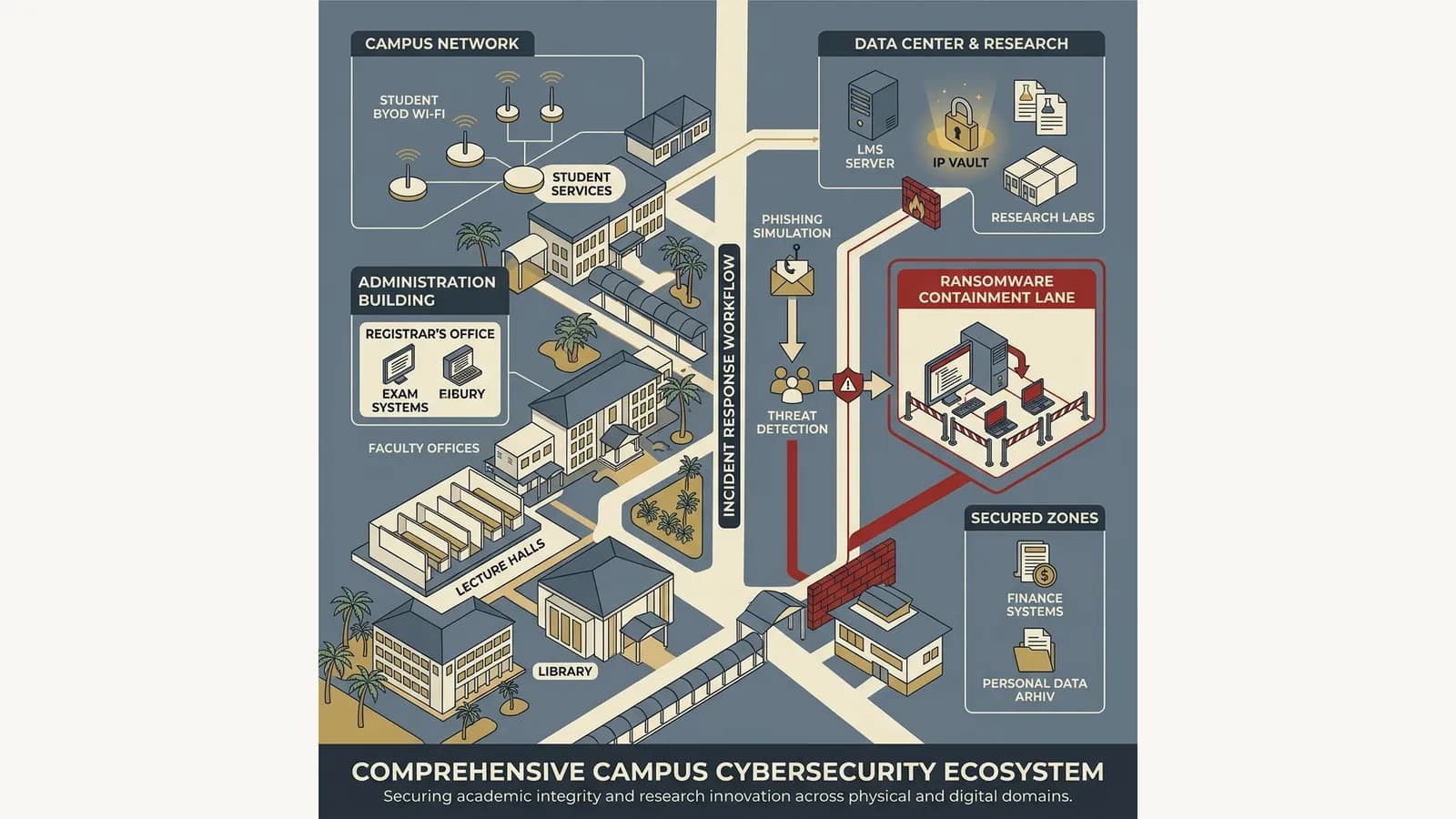
Malaysian universities and schools operate under a structural security disadvantage that has nothing to do with negligence and everything to do with mission. Education exists to be open: open to students, open to researchers, open to the public in ways that financial institutions and corporate enterprises are not. That openness — the open campus network, the open learning management system, the bring-your-own-device culture, the culture of academic collaboration and data sharing — is also the primary attack surface that threat actors exploit.
The threat actor set targeting education is more diverse than most sector security briefings acknowledge. Financially motivated cybercriminal groups target student PII for synthetic identity fraud, staff payroll credentials for business email compromise against bursary and finance teams, and institutional payment systems for direct fraud. Ransomware groups specifically target examination and LMS infrastructure because the operational pressure to restore learning continuity — particularly during examination windows — creates real payment incentive. State-aligned actors have a documented interest in university research data, particularly in technology, materials science, pharmaceutical, and defence-adjacent research disciplines.
A staff member at a public university opens a spear-phishing email impersonating the Ministry of Higher Education, disclosing credentials via a fake login portal. Within 72 hours, attackers move laterally from the compromised staff account to the learning management system and examination platform. File encryption is triggered on the Saturday before a Monday examination week. The institution faces a choice between paying a ransom or running examinations on paper with 48 hours of preparation. The scenario is not hypothetical — variants have occurred at universities in the UK, US, and Southeast Asia. nCrypt's incident response readiness assessment covers this exact continuity scenario, including backup verification and examination-continuity planning.
An attacker exploits a SQL injection vulnerability in the student self-service portal — the kind of web application vulnerability that nCrypt's web application penetration testing routinely identifies — to extract the full student records database. Name, identification number (IC), date of birth, home address, contact details, academic records and financial aid status for every enrolled student are exfiltrated. Under PDPA 2024, this triggers mandatory breach notification obligations. The reputational damage extends beyond the breach itself: regulatory investigation, mandatory notification to affected students, and potential enforcement action.
Business email compromise against university finance teams follows a well-documented pattern. An attacker compromises or spoofs a senior academic's email account and instructs the bursary team to change bank account details for a supplier or grant disbursement. The amounts involved — grant disbursements, scholarship payments, contractor invoices — can run into hundreds of thousands of ringgit. The combination of large transaction values, infrequent payment cycles that make anomalies harder to spot, and staff who may not have received security awareness training makes education finance teams among the most targeted populations in the sector.
A research team at a Malaysian university is collaborating with international partners on a grant-funded materials science project. The shared data repository — a cloud storage bucket provisioned quickly to meet a grant milestone deadline — is configured with overly permissive access controls, effectively making years of research data readable to any authenticated user within the broader university Microsoft 365 tenancy, and in some cases accessible without authentication. A state-aligned threat actor with an established presence on the university network — gained through a BYOD device compromise months earlier — exfiltrates the research corpus without triggering any alert. The loss is discovered only when a competing publication appears with suspiciously similar methodology. nCrypt's vulnerability assessment covers cloud storage and collaboration platform access controls as a standard scope item for research institutions.
A first-year student's personal laptop, infected with a remote access trojan downloaded via a cracked software site during the semester break, connects to the campus Wi-Fi on the first day of term. The malware begins scanning the local network segment. Because the campus Wi-Fi has not been segmented — student wireless traffic shares a VLAN with administrative workstations — the infected device achieves lateral movement to an unpatched administrative machine within hours. This is one of the most common attack paths nCrypt identifies in campus network assessments: flat network architecture that treats the campus perimeter as the trust boundary, when in reality the perimeter includes every student device in Malaysia.
The regulatory environment for Malaysian educational institutions is layered and sector-specific. The foundational obligation is PDPA 2024, which applies to any organisation processing personal data in the course of a commercial transaction. Both private educational institutions and, in relevant contexts, public institutions process student personal data in ways that engage PDPA. The 2024 amendment's mandatory breach notification requirement is the most operationally significant new obligation: institutions that have never had to notify a regulator of a data breach — or notify affected students — now must do so within prescribed timelines following a qualifying incident.
The processing of personal data belonging to minors — which applies to every secondary school and most tertiary pre-university programmes — engages heightened sensitivity considerations under PDPA. While Malaysian law does not yet have a dedicated child online privacy statute equivalent to the US COPPA, the PDPA principles of purpose limitation and proportionality apply with particular force to minor student data. Schools collecting biometric attendance data, health disclosures, learning disorder assessments or disciplinary records must have a clear legal basis, proportionate retention periods, and appropriate access controls.
MOE's guidelines for school network and data security, and MOHE's requirements for private higher education institutions, create sector-specific governance obligations that layer on top of PDPA. These guidelines address secure use of approved LMS platforms, data residency for student records, incident reporting within the ministry hierarchy, and — increasingly — cybersecurity maturity expectations for institutions seeking to maintain or improve their ministry quality ratings. nCrypt designs assessment and advisory engagements to produce evidence that helps prepare for both PDPA enforcement and MOE/MOHE audit expectations simultaneously.
Grant-funded research environments add a third regulatory layer. Research funded by Malaysian government agencies (MOSTI, MRANTI, MoHE research grants) or international funders (European Commission Horizon, US NSF, UK UKRI) may carry data governance obligations that exceed PDPA baseline — including data classification requirements, cross-border data transfer restrictions, and IP ownership obligations. Institutions sharing research data with international partners across cloud platforms must assess whether that sharing is consistent with both grant agreements and PDPA cross-border transfer rules. nCrypt's review methodology maps to these obligations, helping prepare for grant audits and cross-border compliance requirements.
A modern campus has an attack surface that rivals a mid-sized enterprise, distributed across systems that were procured by different departments over different decades, integrated loosely, and administered by IT teams that are typically smaller than their corporate counterparts relative to the estate they manage.
Course materials, assignment submissions, grade records, student-staff communication, and in online examination configurations, proctoring infrastructure. High-value target for ransomware and academic integrity attacks.
Enrolment records, academic transcripts, financial aid data, emergency contact information, and in many institutions, identity document details. PDPA's highest-risk data store for most educational institutions.
Time-sensitive systems where a compromise during an examination window creates maximum operational pressure. Authentication, result integrity, and audit trail controls are the priority assessment surface.
Typically comprises multiple SSIDs (student, staff, IoT, guest) that are often insufficiently segmented. The BYOD ingress point and lateral movement origin for most campus network attack scenarios.
Student fee payment portals, scholarship disbursement systems, supplier payment workflows. Business email compromise and direct payment fraud are the primary threat vectors.
File shares, cloud buckets, Microsoft Teams channels, shared VMs, and laboratory data acquisition systems. Misconfigured access controls are the most common finding in research data assessments.
Database credentials, digital resource platform admin accounts, and interlibrary loan systems. Library administrator credentials are a target for access to subscription academic databases.
Student halls of residence networks are physically on-campus but socially indistinguishable from the public internet in terms of traffic and device management. Should be isolated from academic networks; frequently are not.
Most educational institutions cannot absorb the cost of an enterprise-grade security programme in year one, and they should not have to. nCrypt's phased approach is built around education budget realities — annual budget cycles, grant funding windows, and the need to demonstrate value to governing boards or ministry reviewers at each stage before committing to the next.
Phase 1 — Baseline
Baseline vulnerability assessment of the highest-risk systems: LMS, SIS, student portal, and campus Wi-Fi segmentation review. Produces a risk-prioritised findings report suitable for board presentation and ministry reporting. Identifies the five to ten controls that will deliver the greatest risk reduction per ringgit invested.
Vulnerability Assessment →Phase 2 — Remediation
Targeted remediation support for critical and high findings. Delivered as a guided remediation programme for existing IT staff — nCrypt provides the playbook and technical guidance, the institution's team executes. Keeps cost proportionate while building internal capability.
Phase 3 — Human Layer
Phishing simulation and security awareness training for staff cohorts. Bursary and finance staff, IT administrators, academic staff with research data access, and library administrators are prioritised for targeted campaigns. Training modules are tailored to the specific scenarios most relevant to each cohort — BEC for finance, credential phishing for IT, research data sharing for academics.
Security Training →Phase 4 — Depth Testing
Penetration testing of the web application perimeter — student portal, examination system, bursary payment platform, and any externally facing research collaboration portal. Network penetration testing for institutions with complex campus segmentation requirements. Produces technical evidence for PDPA readiness and MOE/MOHE audit documentation.
Web Application Pentest →Technical controls can reduce the attack surface, but they cannot address the human vector — and in an open campus environment, the human vector is the primary entry point. Phishing simulation and security awareness training are not a soft supplement to technical security: they are a foundational control in any education sector security programme.
The challenge is sector-specific. A corporate security awareness programme runs against a stable, contracted employee population. A university runs against a population that turns over by 25% every year, includes both staff and students with very different roles and risk profiles, and encompasses age groups from 17-year-old pre-university students through to senior academic researchers. A single generic training module does not address this diversity. nCrypt designs education sector phishing simulations with cohort-specific scenarios: a bursary officer receives a spear-phishing email impersonating a ministry supplier; an IT administrator receives a credential harvesting email impersonating the university's own Microsoft 365 tenant; an academic researcher receives a phishing email impersonating a journal publisher with a fake peer-review login.
The simulation results — click-through rates, credential submission rates, reporting rates — become the baseline. Training is deployed to the highest-risk cohorts immediately. Follow-up simulations six months later measure whether the training has moved the baseline. This cycle maps to the continuous security awareness obligation that emerges from both PDPA governance requirements and MOE/MOHE good-practice guidance, and it produces measurable evidence of a functioning human security control programme.
Baseline security assessment of LMS, SIS, exam systems, campus Wi-Fi, and administrative portals. Risk-prioritised findings report scoped for board and MOE/MOHE reporting.
OWASP-methodology pentest of student portals, examination systems, bursary platforms, research repositories, and edtech integrations.
Realistic phishing campaigns against staff and student cohorts, with targeted training modules for bursary/finance, IT, academic, and library staff populations.
Breach notification runbook, DPO governance, student data inventory, cross-border transfer review for international research collaboration. Maps to PDPA 2024 amendment obligations.
Segmentation testing of campus VLANs, Wi-Fi zones, BYOD access control, and residence network isolation. Identifies lateral movement paths from student devices to administrative systems.
Ransomware response playbook, backup verification, continuity planning for examination windows, and tabletop exercise for IT leadership and academic registrar teams.
Yes. The Personal Data Protection Act 2010 — as amended by the Personal Data Protection (Amendment) Act 2024 — applies to any organisation that processes personal data of natural persons in the course of a commercial transaction. Public universities and private educational institutions collecting student enrolment data, contact information, health disclosures, assessment records and financial information are data controllers under PDPA. The 2024 amendment introduces mandatory breach notification obligations: where a personal data breach is likely to result in significant harm to data subjects, the institution must notify the Personal Data Protection Commissioner within a prescribed timeframe and, where appropriate, notify affected students and staff. For an institution holding thousands of student records — including minors — the threshold for significant harm is low. Institutions should update their breach response runbooks and appoint a Data Protection Officer if they meet the prescribed criteria.
Universities are among the most frequently reported ransomware victims globally, and the pattern has appeared in Southeast Asia. The structural reasons are consistent across incidents: educational institutions operate large, open network environments; they are under-resourced relative to financial institutions; they hold data that has value across multiple criminal markets (student PII for synthetic identity fraud, research data for state-aligned actors, payment instrument data from student portals, staff credentials for business email compromise); and — critically — they face enormous operational pressure to restore learning continuity quickly, which creates pressure to pay. The LMS and examination systems compound this: a ransomware incident during an examination window creates both an operational crisis and a reputational crisis. These factors together make the education sector a structurally attractive target.
The Ministry of Education (MOE, governing primary and secondary schools) and the Ministry of Higher Education (MOHE, governing public and private higher education institutions) have published cybersecurity frameworks and guidelines that map to the national cybersecurity policy and NACSA's guidance for the education sector. Requirements typically address data protection for student records, network security baselines for school and campus infrastructure, incident reporting channels within the ministry hierarchy, and secure use of approved learning management systems. Private higher education institutions (private universities, university colleges, colleges) are additionally subject to the Malaysian Qualifications Agency's quality assurance requirements, which include institutional governance obligations that extend to data and IT governance. nCrypt's assessment methodology maps findings to MOE/MOHE relevant guidance as well as to PDPA, helping preparation for both student data regulatory obligations and ministry-level audit expectations.
Corporate BYOD programmes operate under acceptable-use policies with employment contracts as the enforcement mechanism. Universities operate under a fundamentally different social contract: students own their devices outright, have no employment obligation to the institution, use devices across personal and academic workloads simultaneously, and rotate the population every three to four years — meaning the device estate is never stable. This creates several specific risks. Malware ingress: a student's personal device infected during personal browsing connects to campus Wi-Fi and becomes a lateral movement origin point inside the campus network. Credential exfiltration: student email credentials captured on personal devices may be reused across the LMS, the student information system, and any research portal the student has access to. Data egress: research data, exam materials, and other sensitive institutional content downloaded to personal devices leaves the institution's control permanently. Segmented campus Wi-Fi — separating academic from personal traffic, with network access control to restrict unmanaged devices from sensitive VLANs — is the foundational control, and one that nCrypt's vulnerability assessments regularly find absent or misconfigured.
Student records are high-volume, regulated under PDPA, and their breach is operationally damaging. Research data is a different category of risk. Grant-funded research — particularly research funded by government agencies, international foundations, or defence-adjacent programmes — may carry export control, intellectual property restriction, or classification obligations that create legal exposure well beyond a PDPA breach. Research into commercially sensitive areas (materials, pharmaceuticals, energy, semiconductor design) attracts state-aligned threat actors whose interest is economic intelligence collection, not financial fraud. The academic culture of data sharing and open collaboration, while scientifically valuable, creates tension with the data-access controls that protect high-sensitivity research. University research vaults — file shares, laboratory data stores, cloud repositories, collaboration platforms shared with international partners — are frequently found to have access controls that would be considered inadequate in any regulated industry. nCrypt's penetration testing methodology covers research data stores as a distinct attack surface, treating them with the same rigour applied to financial institution data warehouses.
A phishing simulation is a controlled exercise in which nCrypt — with the institution's authorisation — sends realistic-looking phishing emails to staff and students, measures click-through and credential submission rates, and uses the results to target awareness training at the highest-risk cohorts. Education is a particularly high-value sector for phishing because the population is large, mixed-skill, and changes annually. A new intake of students in September is, from a security awareness perspective, an entirely untrained cohort. Staff phishing is a separate concern: bursary and finance staff are targeted by business email compromise attacks impersonating suppliers, grant bodies, or ministry officials. Library staff with administrator access to digital resource platforms are targeted for credential theft. IT administrators are targeted with spear-phishing designed to harvest privileged access. The simulation-and-training cycle helps prepare for real-world phishing campaigns by building a measurable human security baseline — something that technical controls alone cannot achieve in an open campus environment.
Most educational institutions — particularly schools and community colleges — cannot absorb the cost of a full enterprise security programme in year one. nCrypt's phased roadmap approach is designed explicitly for budget-constrained institutions. Phase 1 is typically a baseline vulnerability assessment and a risk-prioritised findings report — a bounded engagement that produces a defensible evidence document and a clear remediation priority order. Phase 2 is targeted remediation support for the highest-severity findings, often delivered through existing IT staff guided by nCrypt's remediation playbook. Phase 3 introduces phishing simulation and security awareness training for staff, scaled to cohort size. Phase 4, for institutions with grant-funded research or sensitive personal data at scale, adds penetration testing of the web application and network perimeter. This progression allows institutions to build security maturity in stages aligned with budget cycles and grant availability, rather than requiring a large upfront commitment.
Online and hybrid examination systems have become core academic infrastructure. nCrypt's web application penetration testing — which maps to the OWASP Testing Guide methodology — covers examination systems as a high-priority target surface. Tests include authentication bypass attempts to access exam content before release windows, privilege escalation testing to identify whether a student-level account can modify grades, result records, or exam configurations, injection testing against result entry forms and API endpoints, and session management testing to determine whether examination sessions can be hijacked or replayed. We also assess the administrative access controls protecting the examination system — whether invigilator and administrator credentials are adequately protected, whether multi-factor authentication is enforced for sensitive operations, and whether audit logging captures the actions needed to detect and evidence tampering. A compromised examination system is not merely a reputational incident — it is an academic integrity crisis with potential legal and accreditation consequences.
30-minute scoping call with a consultant who understands LMS, BYOD, PDPA, and education budget cycles. No generic sales deck.
Request Education Scoping CallShare your scope. We'll respond within 24 hours.
Fill out the form and we'll get back to you within 24 hours.